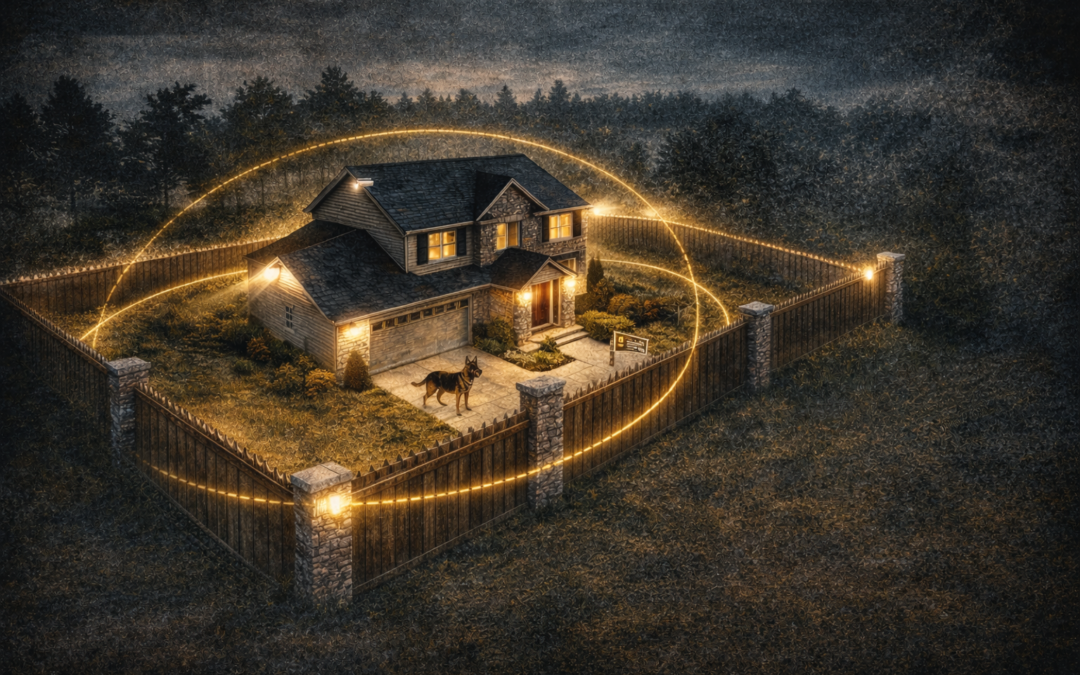
Before we jump into defensive security, let’s start by defining the term.
Security refers to measures we can take to deter a person from harming us or gaining access to our property. Imagine a series of concentric circles, each requiring a given amount of effort or time to defeat. The total effort or time value of all your circles needs to be greater than the value of the property or greater than the response time from enforcement.
I like this definition because it also frames the amount of investment we should make in security. We probably don’t want to spend more on security costs than the protected item is worth. In many cases, you could just put the extra money in the bank as a replacement cost if the item is stolen.
However, this does not take into account extreme circumstances in which the item cannot be replaced. For example, having a generator stolen in the aftermath of a disaster when you need it most, and it cannot be replaced means it has a value that exceeds its cost.
Perimeter and Fencing
The perimeter of the property needs to be clearly defined at a minimum. You want to avoid situations where a person could reasonably say they did not realize they were on your property. Boundaries may be signs, flower beds, shrubs, or a sidewalk. They show the edge of the property but do nothing to restrict a person’s access physically.
Far better than a defined boundary is some sort of barrier. Depending on the degree of security required, the need for certain appearances, and regulations such as homeowners associations, the barriers you can employ may be limited. Basically, you have three choices: some sort of ditch, fence, or plant barrier, preferably in combination.
I always thought of fencing as a way of keeping people out or livestock in. But in Iraq, many yards were walled. A walled yard was usually a great solution that provided a secure perimeter. They were usually in close proximity to the house and made of stone or metal. This also meant that from the government or invading force perspective, we were able to use the cover provided by the walls to get really close to the house before entering to search it.
The walls allowed us to get within hand grenade range, which means in a civil disturbance context, people could get within Molotov cocktail range. It also meant we were hidden from the home’s occupants until the moment we chose to breach. It also meant we were protected from defensive firing coming from the house.
Yard, Plants, Lighting
The area between the perimeter and the house is a balance of clear fields of observation or fire, obstacles, function, and decoration. If you live in a part of the world with high crime, warlords, gangs, or civil unrest, you may need to gravitate more toward the security side of the equation. If you are in a suburb with HOA rules and functional law enforcement you may gravitate more towards the function and appearance side of the equation.
Everything we place between the perimeter and the house may impede our ability to observe what is happening on our property, at the perimeter of the property, and beyond the property, such as adjacent streets, wooded areas, fields, neighboring houses, or buildings.
We may choose to add plants, trees, walkways, fountains, etc.… because they have a function or aesthetic we want. In the case of HOAs and similar rules, they may disguise the function of some other feature on the property. But each object you add has the potential to degrade your field of observation and, if necessary, your field of fire if you had to protect your property.
Based on your needs and the overall situation, you may choose to still implement these objects in ways that manage your observation. In addition to your perimeter barrier, these plants and objects may also provide points of concealment for someone on your property. If you come home at night, does your fencing or plants in your yard provide concealment to someone wanting to rob you or break into your home?
To some degree, these points can be mitigated with lighting. Lighting can be functional, decorative, or both. High-use or high-priority areas such as driveways, detached garages, or gates may be best permanently illuminated. In other areas, such as dark corners of the property, it may be best to use a reactive light that turns on with movement. If the entire property is lit full time it may reveal places a criminal may hide or use to move through. Having some reactive lighting makes the yard more unpredictable and the edges of the lighting harder to calculate. A combination works best.
Decorative lighting can be used to light walkways or to illuminate walls, windows, or doors so someone wanting to break in will be exposed. Usually, if lights are used on walls, they will be on portions of walls so they do not shine into windows, allowing someone to look out without being illuminated.
Dogs, Cameras and Alarms
A dog is a sentry, an alarm, and a deterrent. Dogs are alert day or night. They can hear and smell better than we can. And at least in my dog’s case, he is a pretty good judge of character. Different breeds have different temperaments and may bark more or less than others. If my Akita barks at something, it is worth investigating. In general, regardless of the dog’s size, it is a deterrent to criminals because they raise the alarm and at least have the potential to cause harm.
Cameras are great for seeing what goes bump at night, observing areas of the property and outbuildings not visible from inside the house, and may allow remote viewing while you are away.
Many times, I see people placing cameras too close to doors and looking down. They want to capture a person’s face, but it usually does not allow you to see the person’s actions or enough of the surrounding area to see things like additional people or cars. I prefer cameras to be offset from doors by about 10 feet. The cameras should be angled so that one edge of the viewing angle is lined up with the door so you can see the entire person, what they are carrying, and what their hands are doing. The other edge of the viewing angle should be able to see their face during their approach to the door.
I have one camera on each gate to the yard and to each door to the house. I use a smoked lens so people cannot tell what angle the cameras are pointed. All my cameras are hard-wired. I do not want Wi-Fi-connected cameras because they become additional access points for hacking and can be jammed electronically. I record onto a local hard drive onsite. When you record to the web, it eats up a good bit of bandwidth, and even then, the quality of the videos is usually super degraded in order to push that info to the cloud. If they backed up at full resolution it would be similar to permanently downloading a half-dozen movies all at once.
I also choose when to have my cameras set up for remote access. I have them blocked on my router to prevent them from calling home to the manufacturer or being hacked by a person planning to rob me—or, more likely, a person scanning any cameras in an area to determine who to rob.
Dogs are the best alarms, but they can’t use a phone. Home security systems can monitor doors, windows, movement, and temperature. They can sound an alarm in the house, call you, call a monitoring service, or all of the above. Many can integrate with Smart Home devices such as thermostats and lights. But keep in mind, in the summer of 2023, the FBI put out a warning that any smart home device that touches the internet has the potential to be spying on you. The more smart devices you have, the more diligent and knowledgeable you must be with wifi, internet access, and firewall management.
Doors
When considering points of entry into the home, we should start with the construction of the door, window, or garage door itself.
Exterior-grade doors for commercial purposes are often metal, and if they have a window, it is a practically unbreakable Lexan. For aesthetic reasons, most people would not want a door like this on the front of their house, but I prefer these types of doors for sheds and detached garages. The last thing I want to do is have an easy-to-break-in structure on the property that contains better tools for a criminal to use to break into the house.
Exterior grade home doors may be metal or solid wood. They should also be in a metal or heavy wooden frame. The hinges on exterior doors should be on the inside so the pins cannot be removed from the outside. These hinges should be installed with 3” screws, and security hinges will have a small metal bar that goes into a recessed hole in the hinge plate so the little metal bar goes into the frame when the door is closed. You can also add these bars to standard hinges.
When it comes to locks and deadbolts, the weakest link is usually using short screws on the strike plate where the bolt enters the frame. Just like with the hinges, these should be 3” screws. Pick-resistant and drill-resistant locks are worth the extra money for the deadbolt lock. The downside is that getting new or extra keys may require going through specific locksmiths or the manufacturer.
For any additional locks on doors, the best placement is directly across from the hinges. My preference is a Door Reinforcement Lock. These are easy to install, adding about 800 pounds of resistance when properly installed. Just as with the strike plates, they should be installed with 3” screws.
I had a client who had a stalker who violated the restraining order at her job. Her husband was a pilot, so she was regularly home alone for a week at a time. I went through all the layers of security in the home, and the final concern was how she could defend the home alone if someone got in. I explained she did not have to defend the entire home. Instead, we installed an exterior grade door in the master bedroom. We applied the same locking measures we did on the regular exterior doors. But instead of a deadbolt, we used three reinforcement locks because she did not want guests to see the deadbolt on her bedroom door from the hallway.
Windows
The biggest vulnerability to glass is that it breaks. Generally, glass for windows and sliding glass doors come in single, double, or triple panes. However, there are also differences in the thickness of the glass. When doors use decorative glass, it is often single pane.
The more panes, the better the insulation and the better the security. To determine how many panes your window has hold a lighter or candle next to it. Look at it from at 45 degrees and count the number of flame reflections you see. Each pane will reflect the flame and show you how many panes of glass there are.
You can add security film to the inside of the window that will hold the pieces of glass in place if they are broken. This is great for disasters as well as security. If someone breaks a window it will take forever for them to get through it, if at all with the security film.
The second vulnerability of windows is the locks. These are usually simple locks easily defeated with a crowbar. Security bars can be added for sliding windows to prevent a window from sliding past a certain point. You can limit how far you want to be able to open a window or not allow it to open at all. For casement windows, you can add additional sash locks to increase their resistance.
Traveling around the world, seeing wrought iron bars over doors and windows is completely normal in many places. Sometimes purely functional, sometimes functional and more ornate. If this is something you are considering, plan for how to manage evacuation if you have to escape a fire.
Shotgun
In chapter one, when addressing crime, I recommended taking a defensive pistol course and then purchasing a pistol. The rationale for starting with a pistol is that the training in the course will educate you on safety, handling, marksmanship, and local laws. If you are only going to own one firearm, it should be on your hip and able to be used at home or when traveling.
But for dedicated home defense, I recommend a shotgun for most people. Again, if you are new to firearms or shotguns in particular, seek out local training. What makes a shotgun different from a pistol is lower cost, more flexible ammunition, a lower probability of over-penetration, and a more forgiving accuracy requirement.
If you ever have to use a firearm in self-defense, that firearm will be confiscated until the District Attorney decides whether to prosecute you. I would much rather turn over an easily replaceable shotgun than a more expensive pistol, potentially with its accouterments. By the way, once a firearm is confiscated for any reason, it seems to never be returned.
Shotguns are short-range, primarily defensive firearms, and as such, they usually have the fewest laws applied to them. When it comes to ammunition, you have 000 buckshot (larger) to #4 buckshot (smaller). Then you have lighter loads with many more smaller BBs, #4 birdshot (larger) to #9 birdshot (smaller). You also have slugs, which are single large bullets, some of which are smooth and some rifled for longer-range accuracy.
There are various barrels and ammunition combinations to suit various needs. I recommend the #4 Buckshot for home defense. It is easy to shoot, especially for smaller people, easier to keep on target, and has a lower chance of over-penetration. Over-penetration is when a bullet travels through a target to impact something or someone in another room or next door.
Pistol rounds have a higher probability of this than shotgun rounds. This is because a pistol round is a single, high-velocity round spinning to remain stable. A shotgun shot is a group of BBs at a lower velocity flying in a circular pattern. The shotgun rounds are more likely to get stuck in a target or wall and not travel through to the next room. If they did penetrate the wall, they would be substantially slower and less likely to penetrate a new target.
I recommend a 16” barrel and a full-stock pump shotgun. This barrel is a good compromise between functionality and mobility in tight spaces. Shorter barrels, pistol grips, and various other modifications are available, but how do those other choices look to a District Attorney or jury?
Remember, there are three fights. The first is, are you willing and prepared to use the firearm? The second is, are you able to prevail over an adversary? The third is how likely you are to defend your actions in court and, if so, succeed.
Rifle
A rifle provides the range and volume of fire to defend property as far as you can see in most cases. A semi-automatic will chamber rounds as fast as you can pull the trigger, and a magazine-fed rifle will allow you to reload quickly.
As previously stated, you will get more bang for the buck with an entry-level rifle and spending more money on training. There are plenty of places around the country where you can get training for an AR-15-style rifle. One word of caution is to consider how you will use the weapon and start with training that most accurately addresses those concerns.
For example, if your primary concern is to defend your property and the longest shot you can make is 75 yards without hitting a building or a tree line, then start with training focused on those ranges and those conditions. Buying a large caliber bolt-action rifle and doing a precision long-range shooting course would not be your best first step.
Accessories
There are plenty of people and companies out there that will love to sell you a ton of gun-related things. For every possible accessory, you can find some super-ninja-commando guy out there telling you why you should buy it. And this time next year, he will probably try to sell you something new.
Join a local gun club, attend training courses for your weapon, talk to a variety of real-life shooters and get their opinions, and if at all possible, borrow that accessory or shoot it on someone else’s weapon before buying it. Take your time and be very cautious with YouTube reviews.
When it comes to a rifle sling, the primary purpose is to allow you to carry or retain your weapon if you have to run, jump, climb, crawl, or if you have to transition to another weapon. Consider how you will actually use that sling in that capacity as your selection criteria. A secondary purpose of a sling may be to stabilize the weapon while shooting, standing, or moving. But keep in mind in the real world, unlike some ranges; you can use a variety of immovable objects to help stabilize the weapon for a shot.
Chest rigs, mini-rigs, battle belts, whatever the flavor of the month, you need some way to transport weapon magazines that is accessible for reloads yet retains your gear while running, jumping, climbing, crawling, and shooting from various positions. Again try to test drive before you buy and allow your use and experience to dictate your choices.
You may still hear the occasional old-school shooter say that an optic should cost at least as much as the gun. Not anymore. Today’s manufacturing means that most people can get a good optic for their skill level and use case without spending much money.
I entered the Marine Corps when basic rifle qualification was 500 yards with iron sites. Of course, most of our shooting was at closer ranges, but I had a good ten years and tens of thousands of rounds with iron sites. And another ten years with some iron sites and some optics. So, I am very comfortable with iron sites. The biggest advantage of iron sites is having a wide field of view for close and mid-range targets. The biggest downside beyond the initial training is positively identifying targets without magnification.
If you are choosing an optic field of view versus magnification, that is one concern. The more magnification you have, the less battle space you can observe. But the better to positively identify targets. When I was in the Marine Corps, infantry used a 4x power optic for riflemen, a 2.5-8x power for Designated Marksmen Rifles, and a 10x power for sniper rifles.
Scopes may have additional information in the optic, such as an optical range finder, bullet drop compensator, and windage holdover points. If they are on a fixed-power scope, they never change. If they are on a variable-power scope, there may be only a certain magnification at which that information is accurate. Be sure to check this before purchasing.
Ways to see and shoot in low or no light include flashlights mounted on the weapon, lasers to show you point-of-aim with night vision goggles, night vision scopes or attachments, and thermal scopes or attachments.
Suppressors suppress the sound of the weapon by about 30 decibels. They also suppress the flash signature of the weapon. They come as a direct thread and replace any other type of flash suppressor or muzzle brake, and they come as a Quick Detach easy to screw on and off.
If any of this information is outside your scope of knowledge or is confusing, this is just one more reason to start with training first before spending money.