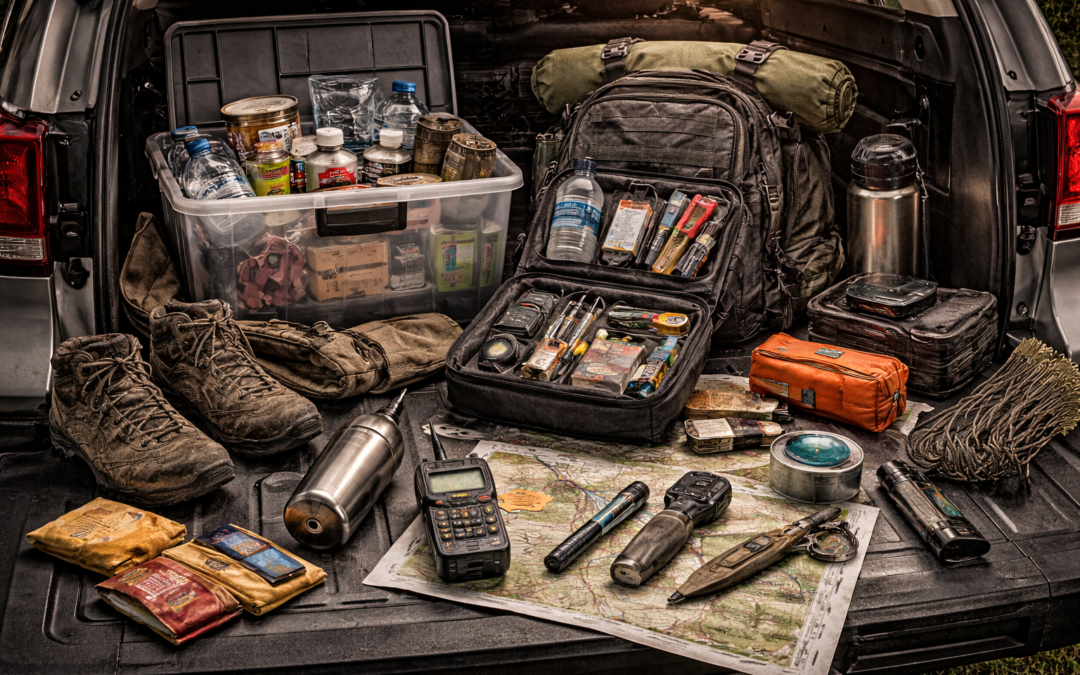
Time to revisit the Bug Out Bag. I still believe that the Version 1.0 bag we did in the beginning, is still more practical than running around looking like you plan on building a log cabin. But based on the overall plans you have put in place and how far you need to go from point A to point B, you may need to revisit certain elements.
Before we get into those individual elements I want to introduce the idea of a supplemental bag/storage container you can put in a vehicle during an emergency. If you need to consume items during your evacuation you take from this container first. If you must abandon the vehicle, your pack inventory will remain intact.
Try to keep your pack to about 10% of your body weight. In general, you are treating an evacuation like an escape and evasion plan. No one purposely enters combat with an 80-pound pack. If you make contact or anticipate contact, you drop your pack. For an E&E plan, you are trying to avoid contact and need to be moving light and fast. The better your supplemental vehicle bag or caches, the lighter you can go.
Returning to the inventory of our Basic BOB Version 1.0, we packed a full set of clothes for each family member in case of fire in the middle of the night or something similar. Now grab a bag of any sort; even a heavy-duty trash bag will work.
Move all those basic clothes and shoes to the new bag. This is the basic clothing bag and will be staged with the BOB. If you need that basic set of clothes in the middle of the night you can grab that bag on the way out the door.
What stays in the bag is a warming layer, a rain layer, a couple of pairs of spare socks, food, and water, but bump it up to 72 hours’ worth. Try to stick to foods that do not need preparation, but try to get something with a good amount of protein. If you have to get water from questionable sources en route, you should have a way to purify it. The easiest way is to use a water bottle with an integrated filter.
The information we compiled in the beginning definitely stays. But now you can add your communication plan, strip maps, evacuation plans, and checkpoints.
A practical first aid kit with just the essentials should be added. The better your training, the fewer things you need. Basic bandages and sports tape or duct tape. You need a strong tape to bind splits or support sprains. I roll off several feet of tape onto my water bottle.
Communications can be as simple as a small battery bank with a charging cable to keep cell phones charged. You may add a GMRS or similar radio, depending on your communications plan.
You should have a plain old compass to aid in navigation. We will discuss navigation in more detail in Part Four. I consider watches, phones, and GPSs nice but supplemental. A plain old compass and map do not need satellites or electricity to function.
As far as security and tools, you may want a loaded spare pistol magazine. You definitely need a fixed-blade knife—nothing expensive. You should look at this knife as disposable. However, it needs to be full-tang and sturdy enough for a wide variety of tasks. Kershaw makes some inexpensive but capable knives. There are plenty of others. But whatever you choose, use it plenty in advance to make sure it performs as you need it to.
You may also want a multi-functional knife. If you are in a more rural environment, you may get more flexibility from something like a Swiss army knife. If you are in a more developed area you may want a multi-tool like a Leatherman. If you choose something with pliers or wire cutters on it make sure they can actually perform on the type of wire you will need to cut. This has long been a weak point for many brands.
A basic fire kit can be as simple as a bit lighter, a basic ferro rod, and the same duct tape on your canteen. Definitely invest some time learning to make fires and using different sources of ignition.
The most basic form of emergency shelter are waterproof bags made of material to reflect body heat. They are not a great longer-term solution, but they are fine for two or three uses to get you from point A to point B.
Overall, remember we are not trying to be a walking REI advertisement. Keep your kit down to the absolute minimum based on your skills. Keep the weight down. Remember you are still more likely to spend a night at a friend’s house or at the hospital emergency room than you are having to walk to grandma’s house through the woods. Best case, this bag stays in your trunk, and you are back home in a day or two. But, just in case…