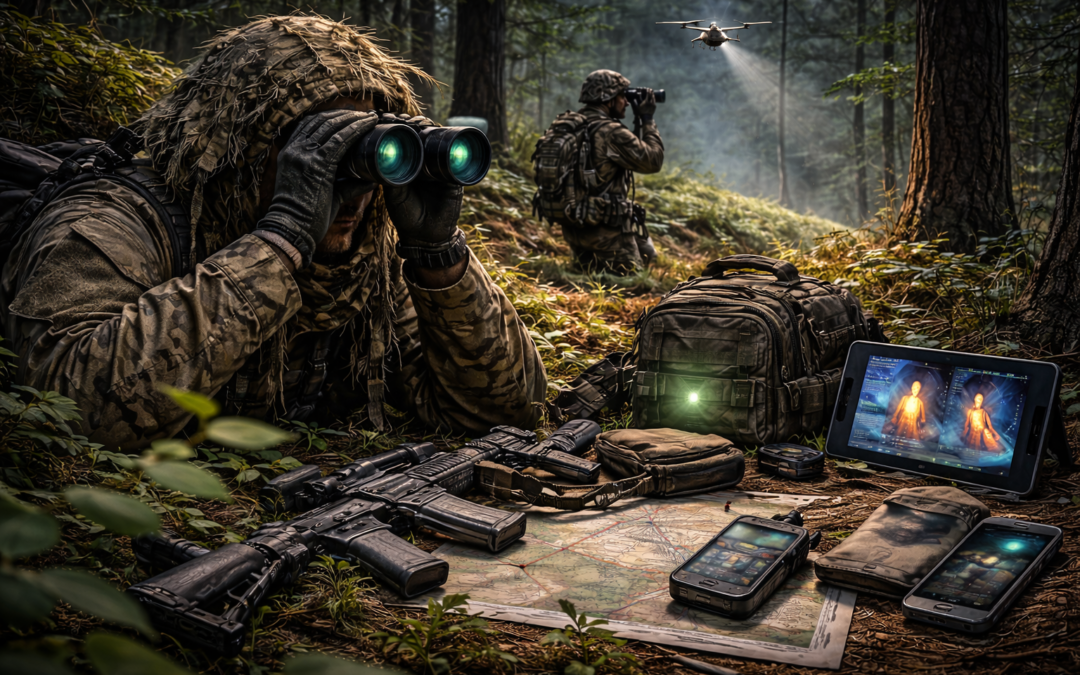
Signature Management involves doing everything you can to ensure others can’t find or recognize you. This includes camouflage, concealment, tactical movement, sound discipline, light discipline, thermal signature, and electronic emissions.
So, if you move from an urban environment into a green belt, put your cell phone into airplane mode, and don some sort of camo poncho, will that suffice? Maybe. But like the answer to most things… it depends.
In the ‘90s, if we were patrolling and the team leader needed to check a map or something similar, we would try to use some masking terrain—terrain that would limit someone else’s observation of us. We would set 360-degree security. The team leader would kneel down and cover himself with a poncho. Then, he would use a red light to read the map.
Today, if you are fighting anything other than Bambi, you need to consider technology commonly available to the general public that used to only be the domain of governments; night vision devices, thermal image devices, drones, and means of monitoring and locating electronic signals.
Camouflage and Baselines
When we say camouflage, most people think of military or hunting camo patterns. In the rural areas near me, you could spend a day in the woods or walk into Walmart wearing clothes like this, and no one would give you a second glance. But in the cities and suburban areas, you would stick out like a sore thumb.
We could discuss all the science of camouflage, but ultimately, it’s just about blending in with your environment. If you are moving through a wooded area or patrolling in a rural environment, make sure the color and pattern of your camouflage actually work for your area and time of year. If you can, do something to break up the very distinct pattern that is the shape of a human head and shoulders.
Green-based camo works well year-round in my area, but I have lived where a green-based camo may work six to nine months out of the year, so a different pattern would be needed in the winter. Set up a camera or have someone take pictures of you from various distances to find what colors and patterns work for you.
But even in the woods, you don’t have to wear camouflage. Depending on the observable distance and rate of movement, you may be sufficiently hidden just by wearing subdued colors—shades of browns, greens, grays, or whatever color is prevalent in your terrain. Black is seldom found in nature in large blotches.
Pay attention to baselines in an urban environment. What do people wear? How new or worn? How clean or dirty? Don’t forget shoes. Are backpacks common? If so, what size? How are they carried on the body? How worn or dirty are they?
In my neighborhood, a laptop-size backpack would not draw much attention. Something bigger would be if it looked subdued, but less so if it was bright REI colors. Fifteen blocks from me, either would likely get you unwanted attention. But a worn, half-empty, poor-fitting, and dirty bag might fit right in there.
In my neighborhood, new, clean, well-fitting clothes would fit better. People commonly walk around, often in pairs. Their posture is more upright, confident, and generally observant in a friendly way. People frequently hold conversations while walking.
The area fifteen blocks away wears more subdued colors. Lots of black, lots of beanies, lots of hoodies. Clothing is more worn and baggy. People often move or stand near bus stops individually. Posture is more of a first-stage limbic response. Rounded shoulders, hands in pockets, generally trying to be unnoticed. Like a kid in school when they did not do their homework and don’t want the teacher to call on them. The pace of movement is slower, and there is less upright looking around while moving.
In my neighborhood, a shiny new European car would go unnoticed, but fifteen blocks away, it would get attention. In that neighborhood, a fifteen-year-old car with duct tape on a window would go unnoticed, but in my neighborhood, it would stand out. However, a five-year-old Toyota could travel between both places without much attention from either.
Once you have established the baseline, start looking for people who stand out. If the baseline is casually present, as I have described in my neighborhood, who is trying not to be seen?
Who stands out if the baseline is subdued and generally trying not to draw attention? Why do they stand out? Are they purposely standing out? If they are purposely standing out, how do people in the baseline react to them? What does that tell you about the status of that person in that environment?
Who stands out from the baseline? Are they target glancing, meaning looking around to see who sees them? Are they slightly bladed, hiding or partially hiding one hand, a pre-contact cue for a weapon being introduced? Does their hand occasionally touch their belt line, a sign of carrying a weapon? Is there a definitive weight shift to the rear foot, a pre-contact cue for a sucker punch? Is there a definitive shift to the front foot, a pre-contact cue for a tackle? Are they “grooming” themselves, these are calming actions when someone is experiencing adrenaline from a freeze, flight, or fight limbic response.
Light and Sound
Before a patrol, we would do a sound check. You would twist left and right and hop up and down a few times. Anything that made noise was then corrected, especially if two pieces of metal touched, such as a rifle sling. The connection would be taped, or if possible, one piece moved or removed, or, in the case of a rifle sling, the fastener would be replaced with 550 cord.
The goal is to be able to run, jump, climb, or crawl with your gear without making much noise. The closer we were to expected contact or setting in an observation position, the more we would ensure that canteens were either full or empty. But not half-full, so they sloshed around. That may sound a little ridiculous, but there was one instance when a patrol was specifically looking for us. They had one person pass on our left and one on our right and never found us. So, the little details matter.
When you move, you need to learn proper foot placement and shifting of weight to be as quiet as possible. You have to practice in the terrain in which you will operate. You need to be aware of what outer garment materials make noise if brushed by limbs and shrubs. You must know and practice hand and arm signals to reduce verbal and radio communication between patrol members.
When you must use light, try to shield it from long-range observation. Red light is preferred because it can not be seen as far away as white light, and it does not wash out your night vision, which is your actual eyeballs’ night vision. Medical personnel use blue so they can still see blood.
Pay attention to light emanations or reflections from glass or metal, such as weapons, watches, cell phones, and observation devices.
Be aware of reflective material sewn into shoes, backpacks, or clothing. Glint material that intentionally reflects to keep you from being hit by a car or shot by an AC-130 Gunship should be covered or removed.
When you wake up early or can’t sleep and end up walking the dog at 4 a.m., you notice a few things. There seem to always be more people moving around than you would expect. People standing in shadows are invisible until they make noise or turn on a light, such as a cell phone screen or lighting a cigarette. You also become aware of how far away that light can be seen even with the ambient street lights in the area.
I know, I know, I know. You got distracted thinking, “How many people still smoke?” Well, people who stand around in shadows at 4 a.m. seem to have a disproportionate number of smokers in the mix. Or maybe I just missed the ones who didn’t smoke.
Observation Devices
As a general rule, in an urban environment, you should assume any movement or action is being recorded by CCTV or cell phone—or at least has the potential to be if you are doing something interesting.
Darkness is the icing on the cake, not the cake itself. Here is what I mean. Once upon a time, darkness could be counted on to hide movement and actions. Now, many people have access to some form of night vision or thermal device, mostly through home security cameras that often come with some degree of low light capability.
There are attachments that add these capabilities to your cell phone. Hunters are increasingly using better night vision and thermal devices.
Your camouflage and movement actions during the day still have to be implemented at night. If no one is watching with a night observation device, then great. The darkness is just an extra layer of protection for you, but you never know who is watching.
I first started using thermal devices in the Marine Corps in 1995. They got better along the way, but my experience with them is dated. I’m sure what governmental organizations have today is far superior. However, what I have seen on the civilian market seems far superior to the devices I used.
Basic movement and camouflage principles still apply. Kneeling, squatting, and prone will help use terrain to reduce your signature from the ground point of view. Trees, shrubs, and rocks will block the view of the observer, assuming you know their directional point of view.
Covering yourself with some sort of camo or poncho may work…. initially. If you need to disappear for 30 seconds, they may help, but as the material warms from your body heat, you will be visible again. If you have to use material for overhead thermal drone protection having a gap of air to slow the warming of the material will be helpful. But the material itself needs to be camouflaged. You don’t want the drone operator wondering what that rectangle in the woods is. Heat-reflective material has been reported to be more effective.
Thermal protection is one of those sciences in its early stages right now. Certainly worth keeping an eye on. I expect we will see many products and tactics in the near future trying to deal with this.
Electronic Signature
Your cell phone and any smart device you carry, such as a watch, are constantly reporting your location. Your phone is constantly reaching out to see if you have incoming calls, texts, emails, or updates to any apps you have on your phone. At a minimum, your location can be triangulated from the cell towers you are connecting to, but it is probably just being reported by your phone’s GPS function.
But what about just turning it off or using airplane mode? In my own experience, as far back as 1996, probably much longer, any cell phone location, microphone access, or camera access could be remotely turned on without the owner’s knowledge. Back then, you could supposedly block this by putting the phone in a microwave or refrigerator or removing the battery. Note that you can’t easily remove cell phone batteries anymore.
Even if you left your phone at home but wore a smart device while you are out and about, all that data will be transferred when your device re-syncs with your phone. The devices likely emit at least a Bluetooth signal, which travels about 35 feet normally but has been picked up as far as 200 feet.
But if you are not in a tyrannical country, one that has been occupied by a foreign nation, or one that is currently experiencing civil unrest, are electronic emissions something you need to be aware of?
Criminals use electronic emissions monitoring, too. They walk through a crowd using an RFID interrogator to gather credit card information if the cards are not in an RFID-blocking wallet. Industrial-scale RFID interrogators are set up on roadways, parking lots, and stores to automatically track shipping containers. They emit a signal strong enough to power the chip in your ID or credit card, which then broadcasts your credentials for the interrogator to read and record.
Criminals are also using AirTags and Tile devices to track cars, luggage, and laptop bags. Usually, to mark a car they want to steal, to find the house the car belongs to, or to track a vehicle in order to abduct a woman or child for human trafficking. You can use a program like AirGuard or BLERadar to tell you when a tracker has been with you and for how long.
Criminals also use electronic scanners to clone vehicle FOB signals. Virtually every car on the road that uses a FOB can be unlocked and started with a cloned signal.
We already covered radios in the Tactical Intelligence portion. However, drone control signals can also be intercepted, and the signal is fairly continuous.
There have been situations in my city where criminals have monitored police radio and deployed drones to track officers and relay the information to others so they can escape.
Persistent or reoccurring signals can be triangulated to determine the location of the emission.
Minimize the number of devices carried and the transmissions from the devices you do carry. Test and use Faraday bags to limit signals from devices when you don’t want them emitting. Let me emphasize: You must test this!
Basic Counter Surveillance
As you may have noticed, the book started with the most common issues people may face and progressively moved towards things that are less likely but have greater consequences.
In the first portion of the book, I discussed awareness and taking action as soon as something did not feel right instead of waiting to figure out why it did not feel right. Now, let’s take this further and examine why it may not feel right.
Time, Environment, Distance, Demeanor (TEDD) are four factors to be familiar with. Have you seen the same person more than once? This is the time factor. Have you seen them in more than one location? This is the environmental factor. Where are those environments close together or further apart? This is the distance factor.
Time, environment, and distance work if a person or team is surveilling you over a period of time, which is not very likely unless you are in a government role or in a specific corporate or organizational role. If a criminal is a general predator then they are more likely to be surveilling the location itself rather than you. In this case, the time and distance factors will not be present.
Therefore, it is still more important that we focus on the demeanor of the individual first and foremost. Because surveillance is not a natural act people often feel out of place doing it. This leads to unconscious actions such as shifting their weight back and forth or target glancing, looking for who is watching or looking at them instead of focusing on a normal activity such as shopping.
Another action they may focus on is people in a crowd instead of whatever the crowd is there for, such as a show, shopping, or waiting for a train. If they come face to face with their target they may feel discovered and abruptly turn away.
People who are properly trained in surveillance may choose to be in character or in costume. They may be a repairman or a surveyor. In order to sell the character as authentic, they need to know the tasks the character would know and be able to carry them out properly. If a criminal chooses such a costume, they will likely lack these details.
Surveillance Detection Routes (SDR) are ways to get to and from regular locations such as home or work by varying your routes, avoiding a straight route to your destination, and adding unnecessary complications to your route, such as cutting over for a block or two before returning to the main road.
If you are walking, an SDR could include stops in stores, using mirrors or windows to look for followers, and changing directions when you leave the store. It could also involve altering your appearance, such as changing a jacket, glasses, or hat. Having a large reusable shopping bag in your laptop bag allows you to remove the pack and place it in the bag when exiting the store. Having a pack other than the basic black gives an observer something to focus on in a crowd, and taking that away may reduce the chance that they reacquire you.
You are looking for pacing activities, meaning they maintain the same or similar distance from you. Varying your pace will expose this. Another activity you are looking for is mirroring or walking the same route as you, changing sides of the street when you do, or transitioning to a car when you do. Look for obstacles that channel traffic, such as a bridge or gate that forces all the people into a narrow space.
Once you believe you are being followed, a cleaning run is essentially an SDR. However, it is more aggressive and complicated than the SDR. By staying in the right lane, you can make last-minute unsignaled turns to the right. You can also drive slowly, perhaps forcing them to pass you if they think they have not yet been compromised.
On foot, you can go around a corner and abruptly stop to window shop or text a message. Then, the observer will be forced to pass you or reveal themselves. You can also walk into a store, walk to the back, and immediately walk back out. The same effect. If they wait outside, this would be a good time to alter your appearance.
Threat Identification
This section was initially part of the awareness section of the general crime section. However, at that stage of the book, it seemed too overwhelming. Now that you have a better overall framework, I have chosen to reintroduce it here as an extension of Countersurveillance. The more you know what to look for, the better you will be at mitigating some of these markers.
Let’s start with the three environmental cues: proxemics, geographics, and atmospherics. As always, you need to know the baseline for your area first. Then, you look for anomalies in that baseline to indicate that you need to make a decision.
Proxemics are spatial relationships in regard to cultural norms, psychosocial factors, and, in our case, tactical considerations. The relative distance between people indicates their familiarity or comfort with each other.
Geographics is the study of terrain and interpreting the relationship between people and their physical surroundings. Criminals move, gather, and hide in generally predictable ways.
Atmospherics describes the interpretation of the environmental mood. This includes how a place looks, tastes, smells, and sounds. Every baseline has an atmosphere that includes every location, crowd, and event. Look for changes to atmospherics from day to day, as well as how things change in the presence of certain people.
The three personal cues are biometrics, iconography and symbolism, and kinesics.
Biometrics, as the term is used here, is an autonomic reaction we all have that is beyond our control. Since it is uncontrollable, it is a good indicator to be aware of.
Iconography and Symbolism. Most cultures, including criminal groups, use symbols and icons to convey meaning. Those who can recognize the symbols used in their area and understand their meanings have an advantage over those who can’t.
Recently, I was in a coffee shop, and the man behind the counter had a nautical star and an anchor on each hand. Four seafaring tattoos, two of which denoted a certain amount of time at sea. I asked when he was in the Navy, he said he was not and asked why I thought he had served. I referenced the meaning of the tattoos, and his answer was, “Just a classic American tattoo, man.” The story’s moral is to understand the meaning before you have something tattooed on your body.
Kinesics is the interpretation of nonverbal cues, which include body language, gestures, facial expressions, grooming habits, and general positioning. The limbic system, which is responsible for survival and emotion, generates these expressions. With the exception of the face, we subconsciously make these expressions.
Here are the two ways I use these charts. First, I regularly go to public spaces where many people hang out or walk by. I try to pick out a few people in each state. Sometimes, you’ll notice a couple who had an argument, a person getting grumpy with a vendor, etc.
When I find someone uncomfortable but does not easily fit into a single category, I pull out my cards and work through the charts until I find three indicators to form a cluster. This helps me learn to recognize the more subtle expressions.
The other way I use the charts is on cards in my Level 2 Self-Defense Course. Once we teach the material, we divide the group into teams of three or more people. The first card they receive is the dominant and submissive card. Each person takes a turn being the reader, the model, and the observer.
They read off one lower body indicator, one upper body indicator, and one hand and arm indicator. Not every indicator goes together perfectly; just adjust if it does not make sense.
Once each person has performed each role for both dominant and submissive, the first team will put a model into one of the positions with three indicators. The other teams decide what state the person is in. They almost never get it wrong.
Then, you move on to the second card, which is uncomfortable or comfortable. Repeat the process. Once you move on to the third card, which is interested or uninterested, you combine those with one of the four states. For example, you combine Dominate Interested, Uncomfortable Uninterested, etc.