During the 2010s, the “prepper” term emerged, describing individuals who were preparing for a future, possibly apocalyptic, event. Television shows depicted extreme personalities, often caricatures of more practical people. The shows largely succeeded in linking “prepper” and “crazy” in public opinion. Now we all find ourselves in a world of greater uncertainty and rapid change. In my experience, many people are closet preppers; they are just careful who they share that with, which is certainly understandable.
As we move through the chapters in this book, I will be sharing my journey, what has worked for me, and what I could have done better. I have been a survivor of a major hurricane and several minor disasters and volunteered at the American Red Cross during significant disasters. I spent 20 years in the Marine Corps in two occupational fields. I was a Scout Observer locating targets, generating intelligence, controlling air and surface fires, and assessing damage. I was also in communications, which included using communication systems and the physical and electronic security of those systems. I was in 13 different operations, including several combat and humanitarian crises. I have Master’s Degrees in Business and Organizational Security Management. I have a degree in Social Psychology and have consulted for companies on security, disaster, and continuity planning. I have been the planner, the responder, and the survivor.
My focus is first and foremost on the events that are most likely to occur in your life: house fires, financial distress, and crime. Then, we will focus on the common secondary effects of bigger disasters, not specific disasters themselves. Those secondary effects include shelter, food, water, energy, security, communication, medical, and sanitation.
One thing I would like you to keep in mind is that skills trump gear. You can buy all the gear in the world, but if you don’t have the skills to use that entry-level item, buying the more expensive item will not improve your situation.
Once upon a time, I did car stereo installations. Back then, you could get a really solid improvement over a stock car stereo for about $1000. Most people would get into a car with the $1000 system and be super-impressed. To get to the next noticeable sound quality, you needed to spend about $3500. Unless they had two cars side by side, most people could not tell the difference.
The $1000 price point got you to the 80% solution. So, was it really worth spending another $3500 to get another 10% improvement? Or to spend another $10,000 to have the very best? Keep in mind that most people could never tell the difference anyway.
In most cases, I will encourage the entry-level 80% solution because that is probably the only solution most people will ever need. But if you are a superstar and are ready to upgrade, you should have the skills for that new piece of gear to actually make a difference.
You can buy a $35 communications radio, or you can buy a $350 radio, or you can buy a $3500 radio. But if the only thing you can do with it is talk one mile to your buddy then what is the point of spending more money? Same thing for a rifle. You can get an entry-level rifle for $600, and most shooters will never get good enough implementing that tool to justify needing a more expensive weapon. Start with entry-level equipment and develop the skills to the point that a better piece of equipment is an immediate step up in your capability.
Along the way, you may feel like there are a lot of things to consider and you don’t have the time, budget, or skill sets to do it all. You probably don’t. You will need to surround yourself with people who have complementary skill sets.
In the world of preparedness you may hear terms for these groups of people such as a Mutual Assistance Group. There may be a place for a group like that at some point. But if you are just getting started how much of an asset to the group will you be right now? If your only role right now is a “taker” and the group is willing to accept you, then there are probably a bunch of other takers in the group as well. If the group does not have some minimum standards, they are probably not worth joining.
So, instead of focusing on a preparedness group, start by inventorying your personal skills and those in your household. What are your current skills in the current world situation? What are your hard skills such as being a carpenter or a mechanic? What are your soft skills such as conversation or networking?
Think about a crisis situation such as a natural disaster like a hurricane, or a prolonged situation such as your country going to war. Not the “over there” wars Americans are used to. But the “right here” war situation in Ukraine. Or the economic collapse happening today in places like Argentina and Venezuela. The 100+ days of civil unrest in Portland in 2020. The rampant degradation of cities such as San Francisco, Seattle, and Chicago that chose to defund and, in many ways, prohibit policing. And, of course, what would happen if there was another pandemic? How do the skills you have translate into those situations?
Now, think about the people already in your circle of friends and acquaintances. What hard and soft skills do they have that would be valuable in a disaster or prolonged degradation of systems of support? What skills are still missing? What skills are important enough that you need several people to perform them?
For example, I know a retired doctor. But not just any doctor. He did a tour in Africa with Doctors without Borders. The first 18 months he was paired with a British doctor who was more experienced. He learned he could not be a specialist, but had to be “the doctor” no matter if the situation required internal medicine or surgery. Then he spent another 18 months being the senior doctor on a team. And oh, by the way, you have to make do with whatever is available, not the convenience of a modern hospital.
I have two people in my circle who do not necessarily have any known hard skills, but they both know a lot of people and build a lot of social capital so people are willing to help them. They are just as valuable as people with hard skills, maybe more so. They have a web of social connections and represent what we call in the military “a force multiplier.”
And why would any of these people help you anyway? One of the things we saw during Hurricane Katrina was public safety personnel not showing up for work and instead taking care of their own families. So what are the chances of members of a “mutual assistance group” executing some plan based on a sentinel event when we may already be in a slow-moving social collapse? At what point do they grab their six-pack of beer and half-a-pack of bologna and head to the woods?
One reason people may help is that they are part of a community rather than a part of a special interest group. Neighborhoods and church or community groups have closer relationships and social pressure to do the right thing. It is possible to meet people because of a common interest, but expecting mutual assistance during a hardship is going to require a stronger social bond.
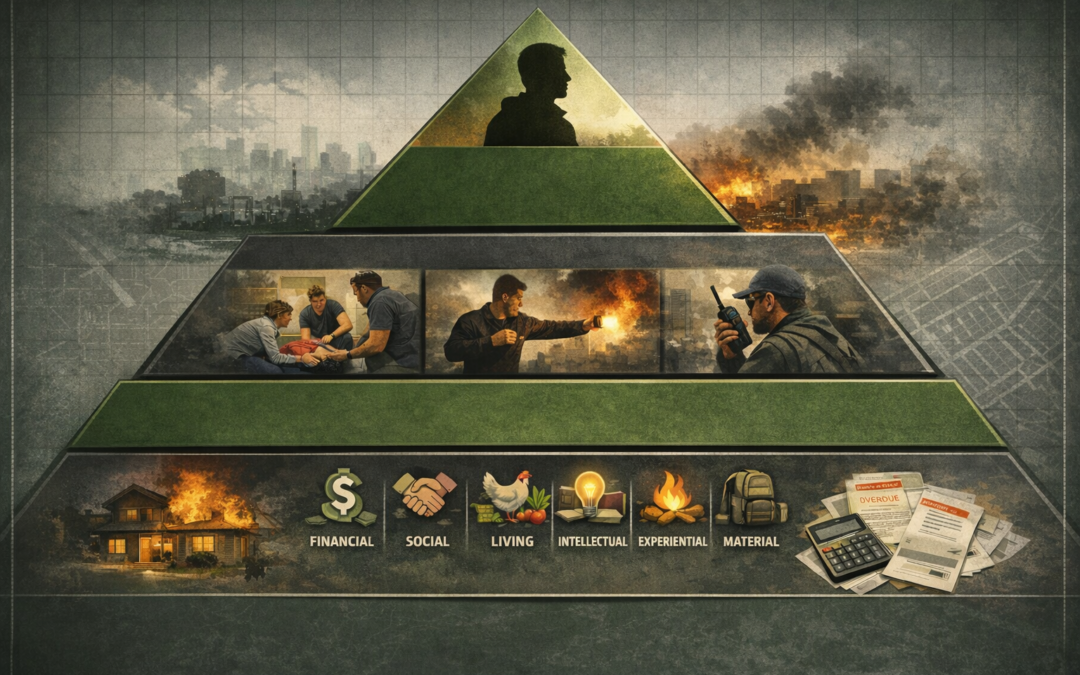
Beyond that, you start getting into various forms of capital. The one we are most familiar with is monetary exchange. I give you dollars, and you give me a good or service for my dollars. However, in the 2001 economic collapse in Argentina, inflation was surging, and bank withdrawals were limited to a few hundred Pesos a day. One writer described cutting links off a gold chain to purchase items. An extension of financial capital is barter. I give you a thing you need, and you give me a thing I need. The obvious limit to this is each of us having the thing the other person needs.
Social capital is when we have a history with a person or group so that when we need something, they are very likely to help. My business is in a building owned by a volunteer-based non-profit. They have no actual paid employees. But since I am there on a daily basis I volunteer to take care of things such as deliveries or fire inspections. When a situation arose and I needed the building owners to make a significant improvement that mostly benefitted my business, there was no hesitation. They made the improvement using their financial capital because I had built up social capital.
Living capital is our soil, plants, and animals, as well as the items they produce, such as food. This makes you less dependent on grocery stores for the entirety of your food needs. If you have a fruit tree with excess fruit and chickens with excess eggs, you can convert the products from your living capital into financial or social capital.
Intellectual capital is the knowing-of-things. This is the kind of information we all learned in school and through our own research. There may be some situations in which having intellectual knowledge is a more important form of capital. But we live in a world today in which most information can be found in a few strokes on a keyboard. However, should that internet-based system of information be degraded how much more valuable would intellectual capital be? It is hard to say; it depends on the type of information and the situation we find ourselves in.
Taking that intellectual capital and applying it to a situation and having a successful outcome becomes experiential capital. The difference between reading about gardening, hunting, trapping, or foraging and actually having experience doing it is worlds apart. Understanding how an engine works and being able to fix one that isn’t is worlds apart. Experiential capital is invaluable in the best of times and even more so when resources are limited. Experience is normally that knowledge you gain shortly after you need it.
Having the information and experience to do something is limited by the material capital you have on hand. Material capital is having both the tools and consumables available to accomplish something. You may know how to fix a roof after a storm. You may have the experience to do it well. But if you don’t have the tools and materials to do the job, you are still unable to fix the roof. I try to do one major project around the house each year. I naturally build my skills and tools and have excess materials on hand if I have to do a similar project or repair in the future.
As you read this book, consider your hard and soft skills. Consider the skills of the people around you and those with whom you have relationships. Consider what forms of capital you have and are accumulating and how those forms of capital might be valuable to the people who have the skills or resources you might need.
Finally, acknowledge that disaster can be a single catastrophic event or a large, slow-moving societal event marked by a series of smaller, sometimes rapid-change events. If you look at preparedness like this instead of only a single world-ending event, you will be more prepared for a variety of outcomes.
I understand that a lot of people get overwhelmed by the topic and just build the “I’m moving to the woods when things go down” bug-out bag. That is an emotional reaction instead of a well-thought-out plan, but I think I understand why it is appealing.
From 2003 to 2007 I was in regular rotations to Iraq. While you are over there you spend a lot of time wanting to be back here. Understandable. But while you are here, you miss being over there and even look forward to going back. I think there are several reasons for this. One reason is that life was so much simpler over there. You were dealing with the planning and execution of the missions. You were reacting to the actions of the enemy. But all of life’s normal pressures were pretty much removed.
You didn’t have to think about shelter, food, or food preparation; your pay was guaranteed and automatically deposited, and bills were automatically paid. Time became relative to specific objectives, not a 9-to-5 work week, and your loved ones were at a distance. The everyday pressures and complications of the modern world were gone. Life was simple.
I think a lot of people in our society have times when they just want to walk away from all the demands of modern life and just live in a van down by the river. And when they become aware of the possibility of impending doom it is too much. Life in the woods becomes “a” plan in the absence of better information to manage the situation. It is appealing because they already want a break from the everyday pressures of life.
I hope the information here will give you more confidence and hope for better crisis management rather than focusing on the obstacles. A person who is threatened thinks, “Let it be over, let it be over.” They will have a thousand chances to change the outcome and never act. A challenged person thinks, “What can I do?” and is way more likely to see opportunities and seize them. Be challenged, not threatened.