House Fire
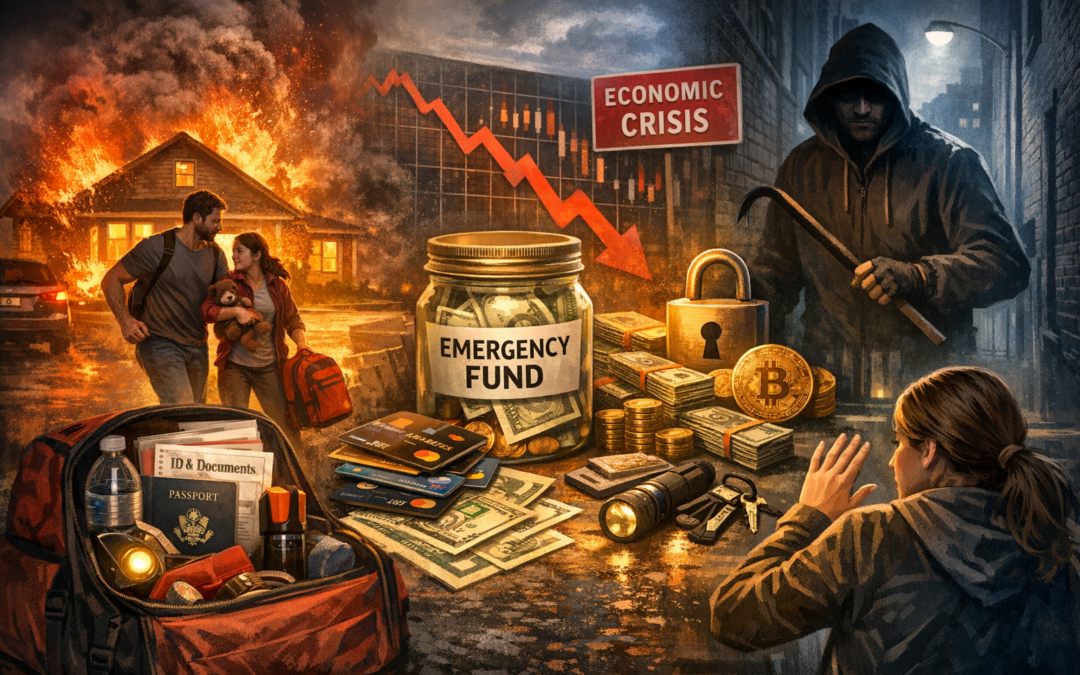
Before we get into the apocalyptic golden calf of preparedness known as Without Rule of Law (WROL), Shit Hits The Fan (SHTF), or The End of the World as We Know It (TEOTWAWKI) I’d like to introduce three topics more likely to happen, and easier to explain to your family without sounding like a conspiracy-nut. House fires, financial distress, and crime are normal disasters even when society is going well.
In the early 2000s, I volunteered for the San Diego Chapter of the American Red Cross. Despite having been in disasters and deployed to humanitarian crises and conflicts in the Marine Corps, I never considered a house fire a “disaster.”
But it was considered the most prevalent disaster according to the American Red Cross. And when you are standing in the street at 2 a.m., watching your house burn down, it certainly is a disaster. Before I go any further about the Red Cross, I understand there are a wide variety of opinions and experiences out there. I personally parted ways with them after Hurricane Katrina. They are responsible for a lot of good, but like any large organization, they are subject to the Iron Law of Bureaucracy. Meaning that those who care about the mission will stay closer to the customer, and those who care about themselves will rise to the top. Enough said.
One of the things I liked about the San Diego Chapter was the emergency response vehicles they had staged and staffed around the county specifically to respond to home fires. The vehicles were stocked with extra-large sweatshirts in adult and children’s sizes, flip-flops, snacks, bottled water, teddy bears, and $500 Visa Gift Cards to get people into a hotel and meet their immediate needs for 24 hours.
So, I’m going to ask you to pause right now and put together those items. Any bag, gym bag, or backpack will do. Gather a set of clothes for each member of the family. Take into account cold or wet weather. A comfort item for children. Food and water that can be consumed without cooking and that will last at least several months. Basic hygiene items in travel sizes that fit in a zip lock bag. Include a travel-size detergent to clean clothes. Add a credit card and stage your kit where you can grab it on the way out the door. This is your crudest version 1.0 bug-out-bag (BOB). Congratulations, you’re well on your way to Mad Max status.
But let’s not pat ourselves on the back just yet. You just did the easy part. The parts I see a lot of people “put off”, which actually means “never get around to,” are the associated planning and paperwork.
As we start gathering information and making improvements to our Version 1.0 BOB, consider what you will need if there is a house fire or if you or a family member needs to spend the night in the emergency room of a hospital. Start gathering the following information and scanning the documents as needed. Actually, put everything on paper in case your phone is lost or broken in the disaster.
Obviously, this is a lot of sensitive information consolidated into one place, so take precautions to protect it but make sure it is accessible when you need it. You may want to scan or photograph all related documents. Place the information in a zip lock or similar bag to keep it dry. As with other sensitive electronic data, ensure you have offsite or secure cloud storage.
Now, give yourself that pat on the back. You did the first hard step, which many people skip until it’s too late. But since we are talking about house fires, go ahead and change the batteries in your fire and carbon monoxide alarms, shake your fire extinguishers, and check the pressure gauge. Make sure everyone knows where to meet if there is a fire.
Financial Distress
On a long enough timeline, everyone has an unexpected bill—sometimes sizable. For most common financial emergencies, having $5000 available will get you through.
Many people prefer to have cash to cover three to six months of bills available. That’s great as well, especially since that highlights how much further your money goes as your debt and monthly payments go down.
Increasingly everything is based on the use of credit or debit cards. However, last summer, I went to the grocery store, and there was a single checkout line open with people backed up halfway across the store.
The manager came out and said their internet was down, so only one register was working—but only if you had cash. Half the people put their food down and walked out. So it is definitely worth having some cash on hand to get you through an emergency. In a larger emergency, it’s best not to need to stand in line for an ATM. Or, like with the store, you may only have the option to buy if you already have cash on hand.
I finished the first draft of this book in Honduras, where I was reminded of what it’s like to be back in an economy that prefers cash transactions. In one instance, it cost us a $7 fee for what amounted to $8 in the local currency. Most purchases we made were offered at a cash-only price or a higher credit card price that included the taxes and fees. I put a Post-it on my passport to remind me to take $200 in twenty’s and $100 in five’s at the minimum going forward.
Building up your financial reserves may take some time, but remember that disasters will not necessarily wait for you to be ready. So balance this with other preparations. Maybe track your total assets and make sure your finances and other preparations are making some progress each month.
Inflation is higher in the post-pandemic era in the United States and around the world. In some cases, it is related to access to raw materials, manufacturing capacity, distribution limitations, etc. Regardless of the cause, whether it is due to malice or incompetence, the reality is that things have changed.
In addition to inflation, many industries are restructuring, at-work versus work-at-home arrangements have changed, and many people have gone to contractor or gig-based jobs. Generally speaking, the kids who graduated high school and entered the workforce during the pandemic simply refuse to work or do not have the skills, education, and work ethic to keep a job.
In general, many people are experiencing downward class migration. This means that you used to be upper middle class, and now you’re middle class, and if things continue on the same trajectory, you may become lower middle class.
So, in the midst of change, it is even more important to reduce unnecessary spending and debt. Part of preparedness is learning to purchase in bulk when possible to reduce total expenses.
Car, home, health, and life insurance, as well as any other insurance specific to your circumstances, should be part of your financial plan. Schedule a review with your agent to ensure the coverages and amounts fit your current situation.
Two disruptive technologies have emerged that can potentially affect the workforce, employment, and alternate economies greatly. Blockchain systems and Artificial Intelligence.
A few years ago, a friend of mine was attacked by her husband. When the police arrived at the home, they asked, “Are there any guns in the house?” To which she answered, “We don’t believe in guns.” The police officer pointed at his pistol and said, “This is a gun. Whether you believe in it or not, it exists.”
I bring this story up because Bitcoin and blockchain technology as a whole are a disruptive technology and a means of currency. When I mention this very often, I hear people say, “I don’t believe in Bitcoin.”
I understand the reluctance, but at this point, it is worth learning how it all works. Personally, I was aware of Bitcoin for a while before I ever invested. Finally, I put in $100 just to get some actual experience with it and to do all the things. I learned more in the few months that followed than I had learned in the several years prior.
The second disruptive technology is Artificial Intelligence, initially in the form of ChatGPT. This will have unforeseen impacts on the workforce. Eventually, it will displace many jobs. However, it may also open some doors to early adopters who may be able to leverage it into a new income stream.
So, I encourage you to explore and understand both of these and be the person who understands and can profit from change, rather than the person who clings to old structures that are becoming obsolete.
Crime
Police are not financed, equipped, or expected to be your bodyguard. Even in the best of times, that is a totally unrealistic expectation. Police forces are meant to go after criminals once a crime has been committed. There are awareness and deterrence programs, but these are a tiny fraction of the force.
Historically, you determine how many stations and patrols are needed to address normal crime levels and the target response time you want. Then, you multiply that number by 3.5 to find out the minimum number of officers needed.
Prior to the “defund the police” movement, the response time in my neighborhood was three minutes. Now that the city has defunded the police, they are only allowed to show up if a person’s life is being threatened. They no longer have a traffic division or a K-9 unit, and property crimes are just an online form so you can file your insurance. They are not even allowed to stop someone from stealing a car right in front of them.
There is also a concerning trend in District Attorneys failing to prosecute people based on race, economics, or politics. Additionally, there is a movement among cities and judges to allow cash-less bail. These policies keep criminals on the streets.
There are three conditions necessary to change behavior:
- Consequences must be immediate.
- They must be consistent.
- The reward or punishment must be significant.
In many places in the country, none of these are present.
Later in the book, I will address security in various ways. But for right now, I’m recommending you pick up the phone and find a local range that offers a pistol self-defense course. Sign up, rent a pistol for the course, and find out more about what you like and how to use it before buying a pistol.
The course should cover safe firearms handling, basic marksmanship, and the laws in your area. Then, you will be better informed to make that first pistol purchase. The instructors will likely try to get you into a range membership or some follow-on courses. If you are a new shooter, it is better to put your money into additional training than stockpiling all the cool guns and gadgets the industry will throw at you.
Awareness
Two pilots are coming in for a landing. One goes down the checklist and says if everything is correct I will land. The other goes down the checklist and says if anything is wrong I take another lap. Which has a better safety record?
The “if anything is wrong” pilot has a better safety record. He gets out of the situation first, then takes time to figure out what was wrong. I could give you a list of pre-violence indicators, and we will consider a few along the way, but it is better that we take the approach of the “if anything is wrong” pilot.
Throughout this blog, we will be referring to the Baseline + Anomaly = Decision formula.
We all have an innate sense of when something is wrong—when something just does not feel right. However, if we live in Western culture, we have a lifetime of contrary conditioning. We don’t want to look silly if we overreact. We don’t want to look like racists, ageists, sexists, etc… We don’t want to hurt someone’s feelings.
Now, like that pilot who says, “If anything is wrong,” we need to learn to trust our innate sense of alarm, remove ourselves from the situation, or otherwise improve our ability to defend ourselves before taking the time to figure out why we feel this way.
What makes up a baseline? Certainly, clothing, movement, social interactions, and patterns of speech make up a group’s baseline. But more importantly, a shared experience. The shared experience will also exhibit itself as shared body language. Everyone is relaxed at the park, or everyone is tense during a race.
We are interested in someone or a group who deviates from the baseline. Usually, the deviation is a difference in body language or not participating in the shared experience.
For example; let’s say you are at a local Farmer’s Market. The vendors have a certain role, the patrons have a certain role, there may be entertainment that has a certain role. You have seen all these before, you know what they look like. You don’t have to pay attention to the details.
Now, lets say you notice someone moving through the crowd, the clothing may be appropriate, their speed of movement may be appropriate, but instead of being interested in the vendors or entertainment, they are looking around to see who is watching them.
We call this target glancing, and you have all seen it. When someone does a quick look around before they snatch a purse, or steal from a vendor, or are preparing to do something more ominous.
It may be better to reposition yourself so you can easily get out of the crowd if you need to than to stand there waiting to see what they do next. If, when repositioning yourself, you see a second person acting similarly to the first, now you increase your sense of urgency.
Sticking with the Farmer’s Market example, another consideration of the baseline is called the “lines of drift.” These are the movement patterns of the various actors. The vendors have certain movement patterns or “pathways” they travel, the shoppers have certain movement patterns, and the entertainers have certain movement patterns. Another anomaly would be someone whose movement was outside these established lines of drift.
Another element to consider is how people in the crowd react to a certain person. For example, a local celebrity, such as an athlete or performer, enters the crowd, and you can imagine they would get a certain amount of attention—probably positive, maybe even a few requests for autographs. So, what would it tell you if someone entered the crowd that people made space for and did not interact with? Maybe someone of a particular occupation or reputation. Maybe someone dangerous.
Environment plays a part in how serious we feel the anomaly is. In my self-defense seminars, we discuss places that support crime. One example I give is a business park next door to an Ikea. The buildings form a right angle to the Ikea parking lot. During the week, the business park is bustling with activity, but on the weekend, it is a ghost town.
Physically, you are 50 yards from the hordes of people coming and going in the Ikea parking lot, but from a visibility and sound aspect, you might as well be on the moon. There is a distinct drone of cars from the highway. You could scream bloody murder, and no one would hear you. A chance interaction in an isolated area is way more dangerous than in a crowded or populated space.
Another environment I show them is a wall of graffiti from a local neighborhood. There may be plenty of people around, but they are less likely to get involved or otherwise come to your rescue. In areas with a significant gang presence, being mugged is a short-term event. Living there may have long-term consequences if they get involved. So, there is a natural aversion to helping an outsider.
Another element of the environment is darkness. Practically every location’s threat level increases during low-light or no-light conditions. Not only can people get closer before being seen, but they also have a better opportunity to escape after the crime.
We need to learn to pay more attention to that innate “something is wrong” feeling, especially in places and times that support crime.
Predators and Prey
During our self-defense seminars, I do a creepy exercise where I talk people through the decision-making process of a predator looking for a victim in a diner. Almost everyone in the room is silent and looks uncomfortable when we do this.
True predators are always hunting. They don’t say, “I have a few hours on Thursday afternoon; maybe I will get lucky.” They are always looking. Before I give an example, I want you to know this is based on reviewing a ridiculous amount of prison interviews with career criminals and psychologists.
This is how a predator goes through the day. This sequence might play out 20 or 50 times before the opportunity and victim align. In this scenario, the final victim was selected and would have no way of knowing how close she came to an assault.
The point of the exercise is not that everyone leaves feeling paranoid but to learn what predators frequently look for and, therefore, how to de-select yourself as a candidate as best as possible.
The main factor is “Are they alone” or “Can they be isolated?” In the diner example, I stated that the room was full, but the only persons of interest were single women.
Another factor is presence. I pointed out that the one woman looked frumpy. Posture, how a person holds themselves, whether they are generally aware of what’s going on around them, and how much time they put into their appearance are all components of presence and communicate to a predator how likely a person is to resist. If they look like a wilted flower, they are less likely to put up a fight.
Albert Desalvo, the Boston Strangler, was responsible for hundreds of rapes and 13 murders. In prison, when asked if anyone ever got away, he said all the time, if anyone fought back, he would just walk around the corner and find someone who wouldn’t.
Another factor of presence I addressed in the diner example was eye contact. When I teach this in person I stand on one side of the room and stage the room so everyone can see my eyes. I make eye contact with another instructor and immediately look down. When I ask what I just communicated, everyone immediately says something along the lines of submission, I just gave up, unwilling to resist. That is the correct answer, which is why we discourage this response.
The second eye contact I hold for about 5 seconds and ask what I just communicated. Here is where we typically get some very different answers. Some feel I communicated that I am confident, and others feel I just challenged the predator. Both are right. Some of the criminals stated that if a person made eye contact with them before the assault they felt the person would be more likely to be able to identify them and choose another target. Some felt they were being challenged and felt obligated to attack the person. Therefore, we also discourage this response.
The third eye contact I make is to meet their gaze, pause for a second, then blink and shift to gaze at a distant nearby target. Something so the predator is still on the edge of my peripheral vision. I met his gaze, saying I see you. I did not hold long enough to challenge. I shifted my vision to something “more interesting,” but I kept the predator at the edge of my vision so they knew I was still aware of them. This is the response we encourage everyone to practice.
Boundaries, Barriers, and Verbal Engagement
In the simplest example, you are walking down a sidewalk. Someone makes you uncomfortable, so you cross the street and continue down that sidewalk. You just made use of a boundary. A boundary such as a sidewalk, street, or bridge defines a generally accepted travel lane or something similar. It does not actually restrict someone else’s movement in any way. However, placing a boundary between you and someone else may be useful.
If you cross the boundary, they may not cross because now you would be an obvious target at a time or place they feel is not ideal or because it may give you too much time to react. If they cross the boundary to match you, you have identified the threat at a distance that gives you more options than if you found out at arm’s length.
A barrier is a physical object a person would have to negotiate to get to you. Common barriers are walls, cars, planters, and rails. A barrier is preferred over a boundary because it buys you more time and clarifies that the person’s intent is harmful.
If it is clear that a person is focused on you, or if the person attempts to talk to you, we will apply a two-stage verbal strategy. Make a clear statement to define your boundary.
“Can you give me some space?”
“I can hear you fine from right there.”
“Can you stop right there? You’re making me uncomfortable”
These are the kinds of responses I typically hear in class. Statements are preferred over questions, but this is how many people talk. Ultimately, whatever you say needs to be practiced in advance and consistent with your speech.
If you are not the person who would normally say, “back the fuck up!” Then saying it for the first time on the street under duress will not sound authentic. Whatever you say has to sound real.
Very often, people will ask for money or ask a question, such as asking for directions, to keep you occupied and to make it seem more natural as they close the distance between you.
It is important to stress that you are under NO OBLIGATION to solve their problems. Even if you know the answer to their question, it is okay to say, “I don’t know.” There is no need to say why or make excuses.
The second stage of verbal is that we cannot move on to dialogue unless they respect the verbal boundary. But if at any point they violate the verbal boundary you cease dialogue and go back to a more forceful verbal boundary setting. At this stage you are trying to punch them with your voice.
Physical Defense
“Assault is generally defined as an intentional act that puts another person in reasonable apprehension of imminent harmful or offensive contact. No physical injury is required, but the actor must have intended to cause a harmful or offensive contact with the victim, and the victim must have thereby been put in immediate apprehension of such a contact.”
In the example above, when we get to the “hit them first and repeatedly” stage, people get nervous and ask about the legal and moral ramifications of hitting first. They also are afraid of the idea of hitting another person, even if they are being threatened.
Let’s review the situation up to this point.
You are alone in a questionable location.
You identify someone who makes you feel concerned. [feared for your life]
You crossed the street to avoid them. [attempted to escape]
They crossed the street and moved toward you. [pursued]
You attempted to establish a verbal boundary.
They encroached to within arm’s length.
What other reason would they have to do this than threaten your body, your property, or your life?
At this point, the assailant has clearly met the criteria for assault, and you were defending yourself.
When it comes to physical defense, this could mean unarmed, in which case it will have to take place within an arm’s length. I advocate for most people to take practical ongoing unarmed defense training. If you do, it must be based on simple gross-motor actions you can perform under duress.
Look for a program or school that does some portion with active resistance, meaning both people are trying to win. The program should emphasize standing, striking, escaping, grappling, and ground fighting as a last resort, not a first course of action.
Another choice in the physical defense response is the use of chemical sprays. When we address this in class, most people don’t know they need to be replaced annually because the pressure can go down. They don’t realize some are a mist that is wide but does not go as far or a stream that goes further but needs to be more accurate.
When we do demos in class with training sprays, people are surprised at the range and coverage area and always surprised by how much ends up on them, either as mist or droplets on their faces. When we do the confined space demo, both parties are soaked.
I’m not saying it has no place in your plan. I’m saying it needs training like any other defensive tool. Unlike the unarmed defense, this gives you the chance and requires you to act earlier with more distance between you and the predator.
This is the point in the class when we point out the challenges of using a knife or gun and the need for continuous training to be effective options.
Finally, we introduce the small handheld high-power flashlight. This allows people to dominate vision at a distance. We integrate it into the verbal phase. If the situation progresses to the physical response, the light can be used as a striking implement.
But the greatest thing about the light is that it is a tool people are willing to use. They are not afraid of overreacting or accidentally engaging a bystander. The worst case is that a person has to take a few minutes for their vision to return to normal.
The overall strategy, the verbal phase, and the physical phase have to be trained in combination. I can get a group of students reasonably proficient at physical defense techniques. We can suit up, ramp up the pressure, and they can adapt pretty quickly in each scenario.
Then we start training the verbal. At first, it’s just the approach and initial “stop right there.” Then we train up to the dialogue phase, feigned compliance, and encroachment. And they freeze. The first time, they either can’t talk or they can’t act. It takes a few tries to get them both talking and fighting in combination.
If you are training with a firearm, make sure you train to use both your voice and the weapon, not just in isolation but together in scenarios.
A few years ago, I was going through Shivworks’ Extreme Close Quarters Concepts (ECQC). The firearms portion of the course uses simunitions, hard wax/dye bullets that hurt like hell when fired at the ranges we were engaged in. I had also gone through the Edged Weapons Overview (EWO). Both of these courses are excellent opportunities to learn to integrate your fighting, weapons, and verbal skills into scenarios. Both courses I attended had a lot of law enforcement officers participating, and it was amazing watching them act out as the bad guys. Details, twitches, rubbing gums, subtle weight shifts, the whole nine yards.
One woman, wearing her duty belt with her hand on her holstered weapon, was in a scenario with an aggressive man with at least a hundred-pound advantage. She was working the verbal phase and controlling the situation when a kid (in protective gear) ran toward her from the side. She immediately drew, shot the big man, and spun to shoot the kid in the chest.
Craig, the instructor, never really tells you if you made the right or wrong decision. He usually says, “Did you consider this?” or “What other ways could this have been solved?” In this case, he asked her what was going through her head when she decided to shoot.
She thought the kid was an accomplice, and if she had turned to face him, the big man would have overrun her. Craig then asked the kid, “What were you saying when you ran out?” The kid replied, “This guy tried to force me into his car.”
Of course, the lady felt like shit. However, my takeaway was the importance of training in scenarios with your verbal and defensive tools. I had at least a decade of scenario training, and I might have made the same decision she did, especially in a gun course, where most of the decisions were to use the firearm.
But in a training situation, we get to take it apart, consider alternatives, run it again, and learn to do it better. If the first time you have to deal with emotions and decision-making in a fast-moving environment is on the street with life-or-death consequences, will you make the best decision possible?
Motivation To Succeed
Every day people with no defensive training at all survive violent encounters. Despite the fact that criminals get to choose the time, the place, the weapon, and the victim they think they can win against. But criminals also want a fast, low-risk payoff. So when someone violently resists them, it increases the risk of getting caught, but more importantly, the criminal risks being injured. The criminal lives in a world where they are very aware that an injury can take them from predator to prey.
So, what is the difference between the victims who successfully resist and those who don’t? Permission, indignation, and mindset.
Unfortunately, we live in a time when people feel they need someone to give them permission to do most things. They have largely abdicated free thinking and inalienable rights expecting the government or some certifying agency to bless them with a permission they did not know they always had.
In our self-defense seminars, we explain from a legal perspective when they can defend themselves, but they still need to give themselves permission to act. And it needs to be done right now, before you are in an overwhelming situation on the street and you freeze.
I give them a worksheet. There are no right or wrong answers, but the more honest you are with yourself, the more useful this will be for you. Start by writing down any of the following statements that apply to you and any variations you can think of.
I give myself permission to act:
When not acting will result in the damage or loss of my personal property.
When not acting will result in the damage or loss of the personal property of someone I love.
When not acting will result in the damage or loss of personal property for anyone.
When not acting will result in my injury or death.
When not acting will result in the injury or death of someone I love.
When not acting will result in the injury or death of anyone.
When not acting may impact my current or future trust in others.
When not acting may impact my current or future intimacy with others.
When not acting may impact my current or future communication in intimate relationships.
Hopefully, you have taken the time to consider these statements and write down the ones that apply to you and perhaps a few others that came to mind. Most participants in the workshops expect the first two categories. But most say they never considered the long-term effects of the third category, especially in a sexual assault situation.
We need to rewrite these into a specific permission statement for ourselves. You can throw it away when you’re done if you like, but it is vitally important that you consider and actually write down the words. Make it as personal as possible, using the actual names of the people in your life or the specific items you are willing to fight for.
I have seen people not willing to fight for a purse or a car but willing to fight for a specific piece of jewelry because of its meaning to them. And very, very often, we see people willing to fight for someone else, especially a child, before they are willing to fight for themselves.
Here is an example:
I give myself permission to act if there will be damage to my personal property or the property of Mary, Jane or Nancy. I give myself permission to act if there will be injury or death for me and anyone counting on me, especially Mary, Jane, or Nancy. I will act if the situation impacts my ability to have intimate relationships now or in the future.
Now the permission statement needs to be combined with the power of indignation. So, what is indignation?
Think about a time when you were the maddest you have ever been with someone or something and how you would have vocalized that anger. When we do this exercise in the self-defense workshops, it is usually expressed as full body tension; people’s faces get demonic, their hands clench, and a deep guttural sound that reaches all the way down into the buttocks comes out as “How dare you!” Or, more often, “Fuuuuuck! You!”
Years ago, I was taking a self-defense instructor course. The instructor told us a story about a mom and daughter who came home to find their front door open. Instead of calling the police, they entered the home. The criminal was still inside, picking up a metal poker from the fireplace and swinging at Mom.
Mom’s arm came up to block, and the metal bar shattered her forearm. The second swing hit Mom in the head. Mom went down on the floor. When Mom saw the daughter getting assaulted. Mom got up and kicked some ass.
At that moment, Mom gave herself permission and found the indignation to fight back. She was more willing to fight for her daughter’s life than for herself.
Permission plus indignation is what gets us from “Let this be over” to “What can I do?” This is the shift in mindset.