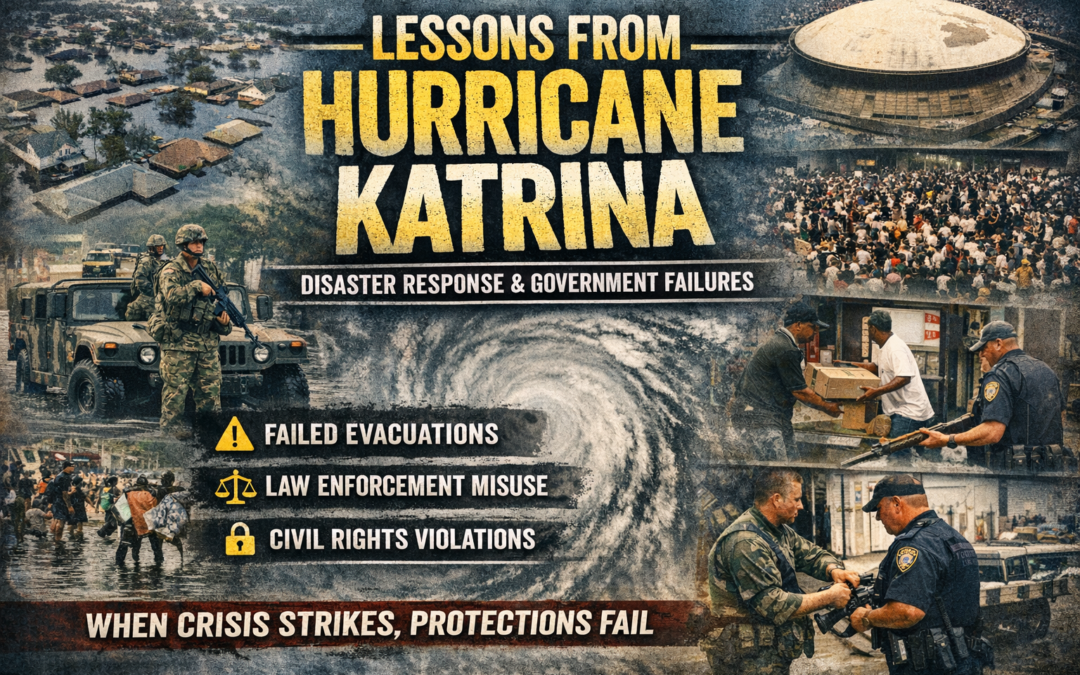
On August 23, 2005, Tropical Depression 12 formed southeast of the Bahamas. One day later, it strengthened to become Tropical Storm Katrina. On August 25th, it became a Category 1 hurricane, and modeling showed it would impact southern Louisiana. The Governor declared a state of emergency, allowing state-level disaster assistance to be utilized.
Much of New Orleans is below sea level. The city built levee and canal systems to manage flooding as far back as 1718. Following the Great Flood of 1927, the U.S. Army Corps of Engineers has managed ongoing improvements to flood control in the region.
On August 26th, Hurricane Katrina became a Category 2 Hurricane, prompting the Mayor of New Orleans to issue an evacuation order 24 hours before landfall. A hurricane training exercise one year earlier revealed that evacuating the area would take 72 hours. Additionally, the response plan following that exercise was still not completed. Evacuation coordination was a failure, and many residents did not have the means to self-evacuate.
I was volunteering at the San Diego Chapter of the American Red Cross, answering calls from the crisis hotline. We would find out where the caller was and direct them to either the nearest aid site or to one en route to their destination. The aid sites were on the periphery of the disaster area and had food, water, and credit cards to help people evacuate. However, they were quickly overwhelmed, and evacuees had to move further and further away to get assistance.
By August 27th, Hurricane Katrina was a Category 3 Hurricane, and shelter sites were opened. Two days later, Hurricane Katrina made landfall. The storm surge breached levees, and the area flooded. Widespread chaos and looting were reported. It was reported that law enforcement officers were failing to show up for duty in many cases. I remember one video on the news showing law enforcement officers participating in the looting. Over 1800 people died during the hurricane and its aftermath. Most died due to drowning.
More than 20,000 people sought shelter at the Super Dome over the course of the disaster. However, poor planning meant there were no supplies to accommodate the evacuees. The Mayor of New Orleans went on The Oprah Winfrey Show and exaggerated the conditions claiming armed gangs and rape inside the Super Dome. This was false but triggered a security response from the state.
The military and Coast Guard began widespread rescue efforts on August 31st. By September 3rd, more than 30,000 National Guardsmen and 10,000 active-duty military personnel arrived in the area. Their duties included police actions, enforcing curfews, and protecting critical infrastructure.
Disaster response and law enforcement are clearly authorized for National Guard units as they are state-controlled assets commanded by the Governor. However, the Posse Comitatus Act specifically prohibits federal troops from engaging in domestic law enforcement against citizens. To complicate things, the National Guard troops were federalized, further blurring the lines.
The legality of these actions came under scrutiny after the crisis. During basic training, military members are educated on what constitutes lawful orders. They take their oaths to The Constitution of the United States, not any military or political office. They are also educated on the Posse Comitatus Act and the legal prohibition of the military being used in a domestic law enforcement capacity. Yet under the extreme circumstances of the disaster, they assumed their actions to be legal and prudent.
One of the controversial actions taken by law enforcement was the confiscation of firearms from residents. This was the disarming of the residents trying to protect themselves from the roaming gangs looting in the aftermath.
In my own experience, as we concluded the initial combat phase of Operation Iraqi Freedom we transitioned to security and stability operations. This included going house to house looking for caches of weapons that could be used to support insurgents. However, we only confiscated an excess of material. We still left one rifle per adult and a basic load of ammunition. This was because, in addition to the insurgents, you also had criminals taking advantage of the chaos. If you completely disarmed the population, you pretty much guaranteed they would become victims.
Confiscations during Hurricane Katrina were found to be unconstitutional and a violation of the Second and Fourth Amendments. However, a court made that decision three years after the action, which did nothing to help those residents during the crisis.
Similarly, the Health Insurance Portability and Accountability Act (HIPPA) was enacted in 1996, protecting individuals’ medical records and personal health information. Yet during the COVID-19 crisis of 2020, employment, attendance, or participation required the disclosure of personal vaccination status in many circumstances. This further shows that protections during normal times may be quickly disregarded during a crisis or perceived crisis.
Perhaps the greatest failure highlighted by Hurricane Katrina was the lack of planning, material support, and communication at every level of government. In the absence of plans, policies, and procedures, communications were either inaccurate or completely absent. In some cases, deliveries were made but never distributed because the information was never passed along. Two years later, FEMA threw out the remaining undelivered stockpile totaling $100 million in material losses.
Again in my own experience in Operation Support Democracy, international aid to Haiti often never made it to the intended recipients. The material would come into the port or airport. Then, without funding to bribe every single local official along the way, the material would sit there and rot. Now, you may be thinking if these large international organizations had planned for this, they would have budgeted for bribes, right?
Under federal law, if these non-profits engage in bribery, they lose their non-profit status. So, is it just a big game where all the players know what to expect, but no one does anything? Maybe. It’s hard to say where incompetence ends and intentional deceit begins.