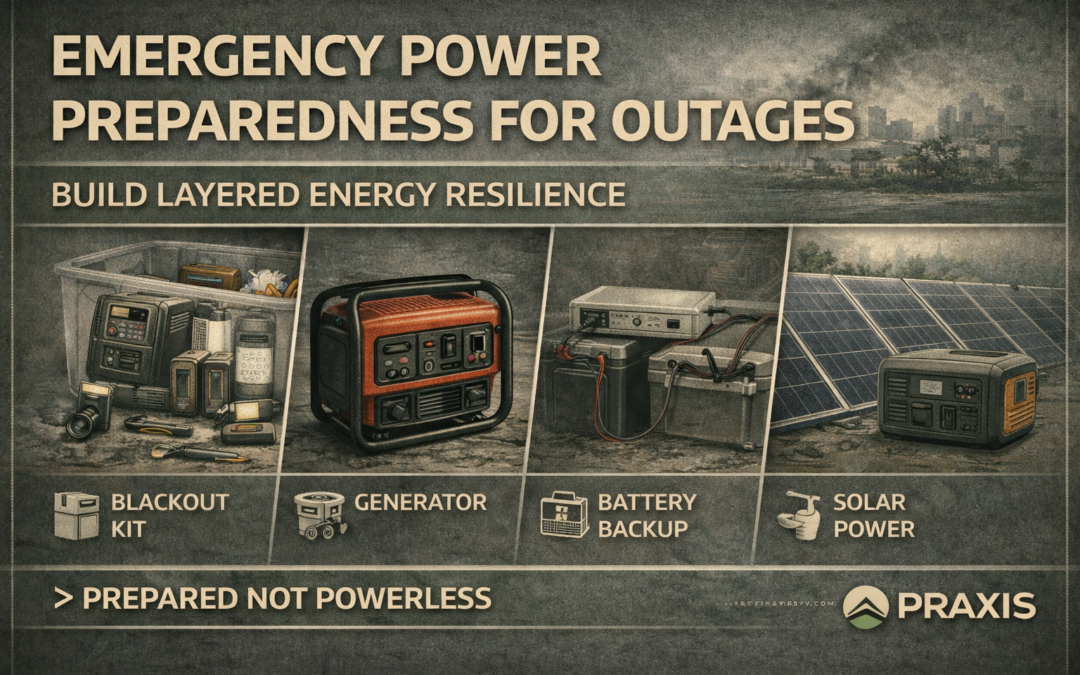
When we consider energy requirements, I like to break them down into two categories: the basic blackout kit and the longer-term disruption.
The basic blackout kit is for that short-term disruption in power that is probably only a few hours. It’s something like a power line down during a storm. First, I have the flashlight beside the bed as part of my bump-in-the-night kit. Then, I have emergency LED night lights in the halls that can be detached and used as flashlights. These are to get me to the blackout kit stored in a plastic tote-style storage box.
In the box, I have a portable 300-watt lithium battery with AC and USB outlets, a set of cables to power cell phones, lights, radios, and laptops, a small rechargeable radio for news, weather, and entertainment, and rechargeable LED lanterns and headlamps.
This was my original, just-getting-started kit for power outages, and still a good first step.
Power Requirements
Like many other people, my first power concern was, “How do I power my refrigerator?”
The first thing I did was find out how much power my refrigerator needed to run, how long it needed to run to get to normal operating temperatures, and how long it would stay cold enough if I didn’t open the door. Then I asked the same questions about my deep freezer.
My refrigerator plan is to move the foods I will eat that day to an ice chest filled with ice I make with an ice maker. That way, I do not need to reopen the refrigerator. Then, I can leave the refrigerator closed for the next six hours until I plug it in again and let it run until the compressor turns off. I do the same thing for the deep freezer.
I run the ice maker and recharge my black-out kit battery at the same time as the freezers. To make this more efficient, I keep water bottles filled two-thirds full in the freezer to take up empty space and serve as a cold “battery.”
My second power concern was, “How do I stay warm?”
My first plan was to use a Lil’ Buddy propane heater to heat one room. But then I discovered I could rewire the kill switch on my natural gas home heat system to accept power from my battery bank or generator. Now I have both.
The switch I use is called an EZ Generator Switch. It is a three-position switch that allows you to select grid power, off or an alternate power connected with a standard three-prong extension cord. It isolates the alternate power to prevent any backfeed into the grid system.
Inverters
Inverters allow us to take DC battery power and convert it to AC power for normal home appliances. Initially, I went with an 800-watt inverter, which I could connect to my car battery while the car was running to power the refrigerator. At the time, I thought that I only needed enough power to run one appliance if needed, which was a good trade-off since the 800-watt inverter was under $60.
At the time, I used 800 watts for the refrigerator, but it spiked to 2200 watts when the compressor turned on. So, I switched to a 1500-watt inverter with 3000-watt peak power. Another thing to remember with an appliance like a refrigerator is that the battery, inverter, or generator may be able to run several appliances simultaneously. But if you have other things plugged in, then add the refrigerator it may trip breakers when the compressor turns on. So start the refrigerator first, then plug in the other appliances. This way, the spike happens with only one appliance plugged in, and then the others just pull a normal load by tripping the breaker.
Generators
The next step up for me was an inverter generator. There are two types of generators: the basic normal generator and the inverter generator. The advantages of the normal generators are that they have more power and lower prices. The advantages of the inverter generators are cleaner power, meaning fewer spikes to protect electronics, and quieter.
I chose the 1800-watt (2300-watt peak) inverter generator mainly for the quieter sound. Since I use the generator to top off batteries I am less concerned about damaging electronics such as cell phones, laptops, or radios since I will charge those items from the batteries. You can also build a three-sided box to muffle the sound of the generator. Just be sure to have adequate ventilation. You may also want to install a grounding rod and a way to chain the generator in place so it is not easily stolen.
No matter what kind of generator you choose, they all have a break-in period. In my case, I had to change the oil after 5 hours of operation, then again after 25 hours, and 50 hours. After that, the normal oil changes take place every 100 hours of operation. So, plan to have oil on hand for several changes, spark plugs, and air filters, and plan to dispose of used oil. My spark plugs and air filter get changed every 100 hours of operation.
I keep a laminated set of instructions zip-tied to the generator. On the back of the card, I track the hours of operation until the next maintenance. You want to be familiar with the operation of the unit before you need it in a disaster. Even then, having the instructions ready when juggling 20 actions during an emergency is helpful.
When I was in Iraq in 1991, we ran a Marine Expeditionary Unit headquarters (bigger than a battalion, smaller than a brigade) off a single 3k generator. Between 1991 and 2003, when I was back in Iraq, the military had become highly computerized, so more power was needed. Those computers also required a lot of air conditioning, so even more power was needed. I was in a brief in 2006 and heard that the cost to supply all that power for the military in Iraq was about one million dollars a day.
So, how did they supply all that power around the clock? Pairing generators in parallel to either share a load or let one take the load while maintenance was being done on the other unit. Usually, they would run one generator for several hours, then alternate to the other. Many modern generators have the capability to perform this function with some additional cables. If this is a capability you may need, be sure to decide before purchasing a generator.
The amount of gas you use depends on the load put on the generator. The more power is required, the more fuel you will burn. Based on my use case of 50% load for 4 hours a day, I use about 3/4 of a gallon of gas a day. I keep 4 five-gallon cans of unleaded on hand. I use Sta-bil fuel stabilizer, and I empty 5 gallons into my car every few months and replace it with fresh gas.
Solar power systems are even quieter than an inverter generator and perpetually fueled, at least in theory. A few approaches exist, and all involve the use of solar panels, charge controllers, batteries, and power inverters.
The solar panels convert sunlight into electricity. How well they do this depends on their construction, temperature, and angle to the sun. The charge controller takes this electricity and charges the batteries. Again, how well this is done depends on the construction, the charge controller’s power rating, and the type of battery. The battery stores the electricity until it is needed. The inverter takes the DC power in the battery and converts it to AC power for your electronics.
One option is a “solar generator.” This has all the components in a single, portable unit. You can lean a solar panel against a fence, run one cable to the unit, and plug in whatever needs power. The downside is that you pay more for this convenience, and because they are portable, the amount of solar power they can take in at once is limited compared to larger home systems.
I chose a 2000-watt system that I expanded to 6000 watts with additional batteries. The maximum power from solar panels is 800 watts. Instead of using the 100-watt solar panel that came with it, I installed two 400-watt panels on the roof of my house. In the summer, I can fully top off the 6k system each day with no problem. However, with cloud cover and lower sun angles in the winter, recharging capacity varies greatly.
Having said that, it still works extremely well within my overall power plan based on my power needs. I can run the refrigerator, freezer, and portable battery for a few hours in the morning and again that evening. Worst case, my batteries drop about 20% a day, and on day 3, I run the gas generator for four hours and top everything off. I still have my car and 1500-watt inverter as a backup.
One option that has come along since I bought my generator and solar setup is solar generator units that can be paired to a specific gas generator. If the battery charge falls too low and the solar panel is not producing, it fires up the gas generator automatically and tops off the battery.
Another option I considered for a while was a 2.4k solar system with an 8k battery bank. This would have been an entirely separate electric system for my house. The cost would have been about double what I paid for my current setup. The battery bank would have had 33% more capacity, but the recharge rate from the solar panels would have been triple. So it would have been pretty much perpetually charged.
These costs were based on me doing the installation, not needing an electrician, not tying to the grid, and not involving permitting or the power company. Additionally, I would have run some stand-alone outlets into a bedroom and the kitchen specific to this system.
In the end, the biggest deterrent to installing this system was that the solar panels would have had to face the street. I think solar panels are ugly, and that was a big part of it. But also, like I said about the grocery store garden that does not look like one, I prefer to keep a lower profile with things like power, communication, and security.
Probably the most common option is the grid-tie, no-battery solar install. This is when you have the panels installed on your roof and wired to your electric panel, enabling the power company to receive your excess supply. You sell them your extra, then buy it back later when you need it, such as at night.
There were financial incentives for this in the past, including a portion of your install cost refunded through federal taxes and higher sell rates for power than your buy rate. The sell and buy rates are now the same in many locations, or the differences are being phased out.
These systems are not terribly expensive and work pretty well for many people. However, they do not help in a grid-down situation. Without your own battery bank, these systems do not produce any power for you when the grid is down. So, from an emergency power point of view, they are not an option.
The other choice is to add a battery bank to a system like this, which at least doubles the price. But, with a battery bank, you have power at night and when the grid is down. This can be a great solution for many, and if your area has financial incentives, it may be worth pursuing.
If you are considering any grid-tie solar, get your actual usage and rate information from your electricity provider. My provider charges 8 cents per kilowatt; it is a publicly owned company, and rate hikes have to be approved by both the city and state. There has only been one rate hike in the last 15 years, and that was 2 cents per kilowatt.
I had more than one company give me solar quotes using national averages for price per kilowatt and frequency of rate increases. According to their numbers, I would break even on a full install in 15 years. But my actual rates meant that I would lose $3000 at 20 years which was the life expectancy of the panels. Of course, you may consider the self-sufficiency aspect and price-in future price increases, and that may work out for you. Just do your homework first.
Propane
Converting electricity to heat is quite literally the very definition of power inefficiency. When it comes to creating heat for cooking and heating I prefer propane or natural gas. If you must use electricity to keep yourself warm consider an electric blanket at 400 watts is a lot less energy than an electric heater at 1800 watts. Do you need to heat the room or just yourself?
In my case, I have natural gas heating. Very often, natural gas will still be usable when the local grid is down, either because of pressure from the natural gas source or from pumps outside the grid-down area. My furnace fan only requires 800 watts and has a 2350-watt surge when turning on. As I said, I use the EZ Generator switch to make it easy for me to power this system with a battery or generator when needed.
However, if natural gas is not available, I have a Lil’ Buddy propane space heater. It is an indoor-safe propane heater for spaces up to 225 square feet. On the low setting, it produces 4000 BTU and uses .044 gallons per hour, so a 20-pound tank of propane will last about 104 hours. The high setting produces 9000 BTU and uses .099 gallons per hour, so a 20-pound tank of propane will last about 46 hours. Larger sizes are available.
Remember, you don’t have to be comfortable. You just need to survive. So wearing layered clothing indoors, using sleeping bags and blankets, and heating just one small central room in your house will stretch out your fuel supply. Have a carbon monoxide alarm in the room, if it goes off just crack a door to other rooms for a bit. If the alarm is going off more often open a window and get some fresh air circulating. I have never set off the carbon monoxide alarm even running the unit all night.
For cooking, I use an outdoor grill. I grill several times a week year-round so my grill is always in use. It works well for cooking on the grill itself, but the cooking eye sucks. In fact, the cooking eye seems to have sucked on every grill I have ever owned. So I have a separate propane burner. I could not get any burn rate specs on it, but it has lasted with regular use at least 6 months on one 20-pound tank of propane.
I keep five 20-pound propane tanks on hand, one of which is being cycled through on the grill. One note on refilling your propane tanks: I have found that tank exchanges usually only have about 18 pounds of fuel in them. I go to a local gas station that refills the tanks all the way to 20 pounds. You may also want to try RV and outdoor stores and dealerships in your area for propane refills.
Batteries and Cables
I try to consolidate my battery usage to as few types of batteries as possible. The main batteries I use are AA, AAA, and 18650. For the AA and AAA, I mostly use rechargeable batteries for daily use items, and lithium for things in storage such as flashlights and headlamps.
Rechargeables have a lower output than alkaline batteries. For example, rechargeable AA and AAA batteries have a 1.2-volt output, while the alkaline and lithium versions have 1.5 volts. Most of my electronics didn’t mind the difference. However, I did have an HVAC remote thermostat that would not run on the 1.2-volt rechargeables. So test your equipment.
I have a handful of other batteries that are more specific to certain equipment. I keep a supply of CR123, CR2032, and CR2 batteries that need to be changed less often but may not be available when you need them.
I also keep a variety of power and data cables for all the equipment I have and other common cables for brands of equipment I do not have. There is not a lot of variety here, but it allows me to charge from any source that becomes available.