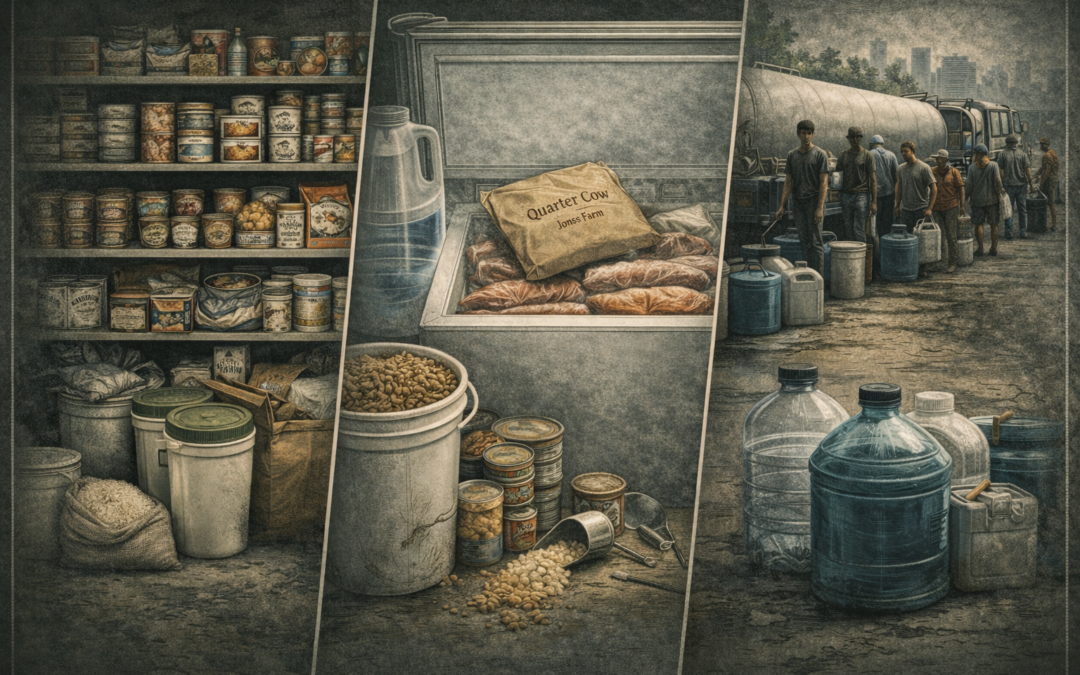
An incoming hurricane is a slow-moving telegraphed punch. People know it’s coming, and the last-minute panic buying will clear the shelves in the grocery store. But the storm itself is a very temporary and predictable event. So buying habits return to normal in a fairly short period of time following the storm. Also, the storm only affects one geographical area.
During the 2020 Pandemic, there was no interruption in toilet paper manufacturing. But people panicked about the lockdowns and stocked up, creating a shortage, feeding more panic, and creating an actual toilet paper shortage. Additionally, the lockdowns covered most of the country at some point. So, even if there is no actual shortage of a product, the perception of shortage can create panic buying and empty the shelves.
So, does that mean you should run out right now and buy up all the food you can afford? No…well, maybe…sorta.
Deep Pantry
Start by building out a deep pantry. This means just stocking up on the foods you normally eat over the course of a month. Look at the non-refrigerated foods that come in a box, a bag, or a can. What is the expiration date? How long is it good for? How many do you eat in a month?
Once you know how many you will go through before the product expires, you can gradually increase your stock without everything expiring at once. You should also gradually eat up the oldest items before they expire. You can take advantage of sales and increase your stocks while bringing down your overall cost.
For this to work, you will need a way to manage your inventory. I store bulk items in one room and move the oldest stock to a pantry closet in the kitchen. Some people set up shelves and load from the back and pull from the front. You’ll have to figure out what works for you, but make sure you have a plan so you are not just eating the newest inventory.
A good starting goal for the deep pantry is 30 days’ worth of food. From there, you can build out to whatever length of time suits your needs, probably something like 90 days to 2 years.
Dry Goods
Dry goods are a great way to boost your food storage. There are some upfront costs in getting food-grade storage containers, lids, and oxygen absorbers. However, dry goods are cheap, and you get many years of storage out of this system. This is a quick way to go from 30 days of food to 6 to 12 months.
When we say dry goods, we are talking about flour, rice, oats, beans, etc. You should also store other ingredients such as salt, sugar, and spices—whatever you need to turn those dry goods into delicious edible items.
Camping and Military Style Rations
When we get into planning, our primary plan will be to shelter in place, live in our own homes, and make the most of the food we have in storage. However, there are situations we will consider that will force you to leave your home, such as a 10,000-acre fire heading your way. Another consideration is that there will be some emergencies in which we can remain at home, but our ability to prepare our food is diminished.
This is a good time to consider camping or military-style field rations. They are usually self-contained, lightweight, and easy to prepare. Some can be eaten cold or just need to be warmed. Others are freeze-dried or dehydrated and will just need boiling water added.
Plenty of companies are willing to sell you everything from 72 hours of food to two years at once. That’s an easy answer. Problem solved. Well… not quite.
Most of these foods taste awful. So, the first thing I would do is buy a single-serving meal from each of the companies you are considering. That will rule out most of them right away.
Now look at the calorie content of the brands you like. Some of them have extremely low protein and calorie content. Remember that the USDA 2000 calorie-a-day number they put on food labels is based on a 150-pound man. So, how many of these meals will you actually need per day, per person?
Additionally, considering all your other food preparedness, how many days’ worth do you actually need? For me, the answer was to start with 72 hours and then catch brands on sale and stock up to 10 days’ worth. I only eat these when camping, so I do not often rotate stock. I don’t want to end up with a lot of this stuff that is relatively expensive and never gets eaten.
While I do have a few days’ worth of dehydrated food in individual single-serving-size packages, the bulk of the dehydrated food I store is in #10 cans. One #10 can of Mountain House spaghetti is 7 servings at 240 calories per serving, and the can is resealable. Maybe two days of meals per person when combined with a couple of cans of food and dry goods such as rice.
Deep Freezer
From here, the next big step for me was to add a deep freezer. I looked around for a local farm from which I could buy a quarter cow. When I tell people I bought a quarter cow, they usually ask what quarter I got. Well, it does not work that way. You get a quarter of the steak, a quarter of the ribs, a quarter of the roasts, a quarter of the ground beef. And when I say local, I am willing to drive 100 miles or so because I only do it once or twice a year.
I have a 9 cubic foot chest freezer. It will hold a quarter cow and a half pig. That will completely pack it with a little leftover in my regular refrigerator freezer. Usually, when you find a farm, they only butcher a certain number of animals per month. Usually cow, pig, and lamb. You may have to put down a deposit and wait a couple of months for your animal. Since you are paying according to the total weight of your portion you are paying the same no matter the cut of meat. I get my steaks, roasts, ribs, and ground beef all for about the same price as ground beef at the supermarket.
Once your order comes up, they will usually contact you, give you a list of meats, and ask how you want it processed. For example, do you want sirloin as steaks or ground beef? I turn any of the cuts I am unfamiliar with into ground beef. They will probably ask how thick you want your steaks. They will also usually ask how many steaks, or ribs, or pounds of ground beef you want per package. They will ask the same for the pork, also do you want your hams and bacon cured or not, and what cuts do you want made into breakfast sausage? They will also ask if you want the brain, tongue, liver, pig fat, or dog bones.
This is a great way to start establishing a relationship for meat if the supply to your local store is disrupted. I almost always have a deposit down for my next freezer resupply.
I also have a local butcher that gives me a 20% discount if I buy a package of $100 or more. This is a way to restock some of the cuts of meat I go through faster than others. I also usually get a “summer pack” from him: ground beef, chicken, hot dogs, and sausages.
Usually, I just get individually sealed chicken breasts in bulk from Costco. But you may want to look around and see if you have a poultry farm close enough for you to buy directly.
Another source for bulk meat and bulk food in general is a restaurant supply store. You do not have to own a restaurant to buy from them. These should be available in every city. Note that some meat purchases here will require you to learn some basic butcher skills.
Local Farms and Community Supported Agriculture
Another farm relationship you may want to explore is if you have any Community Supported Agriculture (CSA) farms in your area. You buy a share of the crop, usually at the beginning of the season. However, some farms will let you join on a month-by-month basis. In either case, they will usually accept a maximum number of members.
This membership gets you a box of fruits and vegetables every week, or two weeks, or month. The amount you get is based on your share of the crop so when the farm does well you get more food. Often they will have a relationship with other nearby farms to trade their excess so you get more variety.
The big plus to a CSA is that each farm only takes so many members, and you are guaranteed a supply of food even if the supermarket is having supply-chain issues. The downside is that CSAs are usually more expensive than grocery stores. Sometimes, they deliver, and sometimes, you have to pick it up from the farm. Some will have pickup points on certain days or someplace like a farmers market to pick up your share.
Some farms will allow you to make adjustments online before you pick up your order—more of this and less of that. That also means the other big drawback is ending up with food you either don’t like or don’t know what to do with. So be prepared to learn some new recipes. Finally, you are getting what is in season, so the variety will be far less than what you are used to from the grocery store.
Annual Gardening
As with every other aspect of preparedness, nothing beats actual first-hand experience, especially with gardening. You have to just to get out there and do it—and get better next year and the year after that. If you have never gardened, start small, get some seeds and put them in the ground, and start getting experience. You can read all you want and talk to Master Gardeners in your neighborhood, but some things you just have to do for yourself.
Start with whatever pots or plots of dirt you have. Don’t get too caught up in building raised beds or whatever in the beginning. Pick a few vegetables you like and start small. Maybe just a salsa garden. The information and experience you get from just one season will steer what information you want more of and how to apply it. By season two, you will be smarter, have a better plan, and have a much more productive season.
Community Gardens are a great way to meet like-minded neighbors and get first-hand knowledge of what works best in your area, especially if you live in a city and do not have a lot of land to work with. Community gardens are typically odd pieces of city—or county-owned land they can’t really do anything with or land owned by non-profits such as churches.
The goal is to make mistakes now while the consequences are low and you can ask more experienced people for help.
Backyard Chickens
Backyard chickens are a great source of protein. They are a daily source of egg production and, eventually, Sunday dinner. My first chickens were 5 Rhode Island Reds. They were great egg producers even in the winter. As the daylight diminishes so does egg production for many breeds in many places.
But there were more birds than we needed. Very quickly, we had more eggs than we could use and started giving them away to friends and family. The eggs from home production are unlike anything you can get in a store. They taste way better, and the yolks are orange instead of yellow.
Having 5 birds meant we spent a lot more on feed than what the birds could forage in our garden at the time. So, for the size of my lot, the size of my garden, the number of eggs we consume, the right number of chickens for me is 3. However, if I had more land, a bigger garden, wanted to eat more eggs, or wanted eggs for barter I would have a bigger flock.
The other benefit of the chickens is poop. I have a fenced chicken area around the coop. All my compostable food waste, garden waste, and grass clippings go into the chicken area. The chickens eat, scratch, and poop it into nitrogen-rich soil. But that soil is too hot for many plants, so you may need a place to move it to while it cools.
Guerrilla Gardening
Our yards, community garden plots, or whatever land we access is part of the greater ecosystem. Nature does not know where your property line stops. Guerrilla Gardening is planting on land you do not own, usually in the public space.
We have a large city park that has some pretty remote isolated areas. I became aware of guerrilla gardening when I found out people had planted various shrubs and herbs in those isolated areas. There have been instances of groups of people grafting branches of fruiting trees onto the decorative versions to make them bear fruit. I personally do not know how well this works. Other people will plant herbs and flowers along the sides of alleys in the city.
If you have many locations around the area that you plant from seed, the cost is minimal, and you have diversified your supply locations. In most instances, people do not even know what they are seeing and don’t care what is there one way or the other.
Seed bombs involve taking all the leftover seed, putting it in a container, and shaking it up. Then, walk around and casually spread a mix of seeds in different areas so that whatever is best suited to that location and conditions will grow.
Perennial Gardening
When I got started gardening I put up a couple of raised beds with more emphasis on appearance than function. Eventually, there were 14 raised beds, the border was framed off, and the walkways were cedar chipped. I put too much time, effort, and money into that project.
Along the way, I gravitated toward vegetables that grew best instead of what we actually wanted to eat. Our yields went up but not quite to a level where preserving made sense. We did do some experimenting with dehydrating and canning, but it was more for gaining the experience than it was a significant contribution to food stores.
I learned that I spent a lot of time every year cultivating vegetables I don’t like. So I pulled out all 14 of those raised beds. Eventually I put back a few with an automated watering system and only the veggies we actually eat regularly.
Enter perennial gardening. I have 20 dwarf fruit trees and 14 different kinds of berries in my yard, so I have something ready to pick from mid-spring until mid-fall. Two-thirds of my edge-of-urban lot is a food forest, and the yard is bordered by a fence covered with edible or productive vines. Outside the fence is the top canopy of Vine-Maple trees.
The goals for building out my food forest were to have a decent production of food available through as many seasons as possible, to do it in a visually attractive way that also reasonably disguised the fact that it is a natural grocery store, and to do it in a self-sustaining way that does not require ongoing inputs such as pest control or fertilizer.
There are seven layers in a natural forest: the top canopy, the sub-canopy, vines, shrubs, herbs, ground cover, and the sub-surface. I understood that if you don’t provide all these elements, over time, nature will. So, I did my best to fill all the needs along the way.
Being on the urban edge, the weakest part of my ecosystem is the top canopy. I do have forests, green belts, and nearby parks with full-height top canopy, but the nearest to my house is about 500 meters away. The top canopy provides windbreaks and a habitat for birds and small animals. The closest I come to this function is with Vine-Maple trees planted in the strip between the sidewalk and the street.
My sub-canopy is a variety of fruit and nut trees on dwarf stock, so they only get about 15 feet tall and require very little, if any, maintenance. Several cultivars of stone fruit are produced from mid-spring until mid-summer. Cherry production overlaps with the end of this season. Then, several varieties of pear grafted on the same three trees are ripe at different times into the fall.
I planted the trees in a few waves over several years. Together, I have probably planted about 30 trees. Some just didn’t thrive and had to be replaced three or four years in. Others thrived to maturity but failed to produce fruit and had to be replaced.
My yard has a gentle slope, so I dug shallow swales to capture water. If a ditch is more of a V shape, a swale is more of a U shape. My swales are about eight inches deep and about two feet wide. I also redirected a downspout from my rain gutter to feed one of the swales. The swales are on the downhill side of the house, so any spillover goes away from the house into the yard. The swales are used to water the trees.
Like most urban and urban-edge yards, I had compacted, lifeless dirt that only supported grass and weeds. So, the portion of the yard that was going to be the food forest needed soil remediation. I called the power company and several tree services in the area and asked for wood chips. These were all free for me. But you have to take the entire load, and it is just whatever trees they happen to be trimming that day.
At this stage, having wood from a variety of sources was perfect for my purposes. I covered the area with cardboard for weed suppression, soaked it down with water, and covered the area with 6-8 inches of wood chips, deeper in the swales to make everything appear level. Within a few months, the wood chips had dropped to about 4-5 inches of coverage, which was still enough to keep the weeds out.
All winter, it rained, and the wood chips started to breakdown, causing microbial life to move into the soil. The following spring, I had a variety of inedible mushrooms and all sorts of strange fungal things popping up. About three years later, I refreshed the bed with more mixed wood chips, and about three years after that, I switched to cedar chips for the pathways.
At that point, my soil was dark, deep, and fluffy, with lots of crawly things in it. I switched to cedar for the pathways because it lasts a lot longer and naturally suppresses weeds.
I put in a mix of nitrogen-fixing and edible plants for the shrub and vine layers. Nitrogen-fixing plants have a symbiotic relationship with bacteria on their roots. The bacteria create nitrogen. When you cut back a significant portion of the branches on these plants a portion of the roots die back as well. When this happens the bacteria die and release the nitrogen into the soil for other plants to consume.
My fence is made of galvanized steel wire panels with four-inch holes supported by a wooden frame. It needed to look attractive for the neighbors, be strong enough to support the weight of the vines, and not get “eaten” by the plants it was meant to hold up. Most of the fence is covered with Japanese Honeysuckle. They are nitrogen-fixing, smell great about half the year, attract pollinators such as bees and hummingbirds, and have sweet edible flowers.
I have autumn olive shrubs between every other tree and in several other “traditional flower beds.” They are also nitrogen-fixing and fast-growing. The fruit is edible but not something you would normally harvest, although birds and small animals like it.
The remaining shrubs throughout the food forest and the rest of the yard are mostly berry bushes. I planted 14 different berries according to their light and watering requirements. I spread them around to reduce the risk of disease or bugs eating them all at once, and I also vary the cultivars to make them more resilient.
Portions of the yard have herbs, and other areas have ground covers. Some are edible, many are medicinal, and they also help with water retention in areas not wood-chipped. Most of these plants have small flowers. One of the main goals for my herb and ground covers is habitat for beneficial insects. Having dill, clover, fennel, and yarrow spread around the yard is great for ladybugs, which in turn control aphids.
If you are interested in going deeper into this approach to gardening, I recommend Gaia’s Garden by Toby Hemingway.
Water
A common recommendation is to store at least one gallon per person per day. I prefer three gallons per person, per day. Remember, you are storing water for drinking, cooking, cleaning, sanitation, and flushing toilets. Toilets flush by water pressure. So if your water supply still has pressure you can flush toilets even if the water supply is non-potable. That also means if the water supply is disrupted you can flush the toilets with water you already used for cleaning, sanitation, or cooking.
I have a few cases of bottled water that can be consumed in the home if necessary but is meant to be used if evacuation is necessary. I store these with a Grayle Water Bottle, a container with a built-in filter. You fill the container and press down the filtered portion, and it leaves you with a container of water you can pour into another container if necessary. I prefer these over water bottles with filtered straws because you can’t move that filtered water for cooking or additional storage.
I have five-gallon containers with handles and a spout so you can place them on counters and easily get water for drinking or cooking. This is the bulk of my stored water, the portion that makes up the 3 gallons per person per day.
The waterBOB is a 100-gallon bag that can be placed in a bathtub. You fill it from the faucet, and it has a hand pump to move the water to smaller containers. This is a great way to boost your water storage if you have some notice of an impending event or in the early stages of an event. If I use the waterBOB, this will be the first water storage I use up.
I have two 50-gallon water containers that receive water from a downspout on my house gutter system. There is a screen filter to remove big things, including a lot of bird poop. On a daily basis, this water is used to water the parts of the garden that still require irrigation. As is this water can be used for toilets, maybe some cleaning, but for drinking or cooking it needs to be purified. One way to configure these is to feed them from your water hose instead of roof runoff. This means the water is cleaner and is naturally cycled more frequently.
I have a nearby stream in an on-the-edge-of-urban greenbelt. Usually, the water is clear, but after a dry period, the first rains will rinse off oil and other contaminants into the stream. If I needed water from here at any time, I would filter it, but I would avoid using it during those times with visible contaminants.
I have a large gravity-fed filter system on the counter in my kitchen to filter everyday drinking water from the tap, which can also be used to filter water from other sources during an emergency. These types of filters have a standard charcoal filter that works for pretty much all the normal organic concerns, as well as a variety of chemicals, heavy metals, and pharmaceuticals. I also have gallons of bleach and iodine tabs on hand if needed.
Water that has been stored for a while may have a stale taste. Water treated with bleach or iodine will also have a chemical taste. To help with this, you may want a supply of instant coffee, powdered Gatorade, Kool-Aid packs, or something similar to flavor the water and make it more appealing.
Basic methods of purifying water start with pre-filtering by putting a cloth over the container mouth to filter out any debris. Water can then be purified by boiling it for 1 minute or 3 minutes if above 6,500 feet. Water can also be purified with sodium hypochlorite, iodine, or ultraviolet light.
You may find that maintaining clean water consumes much more time and effort than you expect. If you have large stores of non-potable water onsite, it may take an hour or so a day to replace stores of potable water. If you have to leave the property, then the amount of water you can transport is limited by weight, possibly requiring multiple trips and having to provide security throughout. You may find water consumes several hours a day.